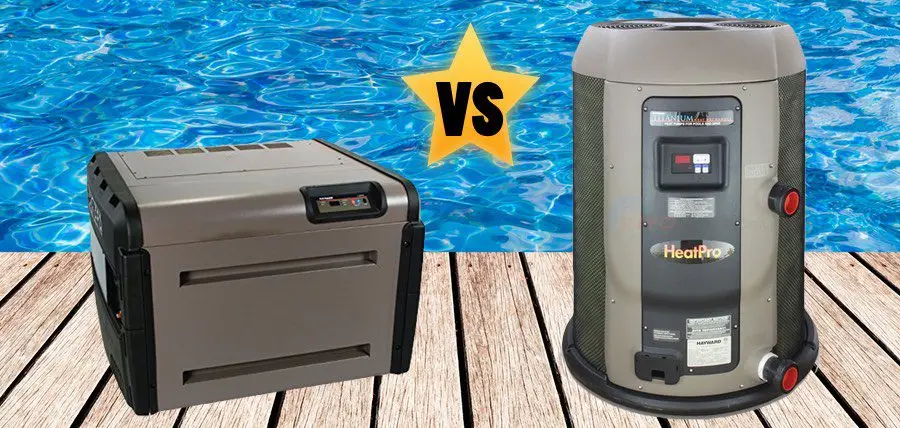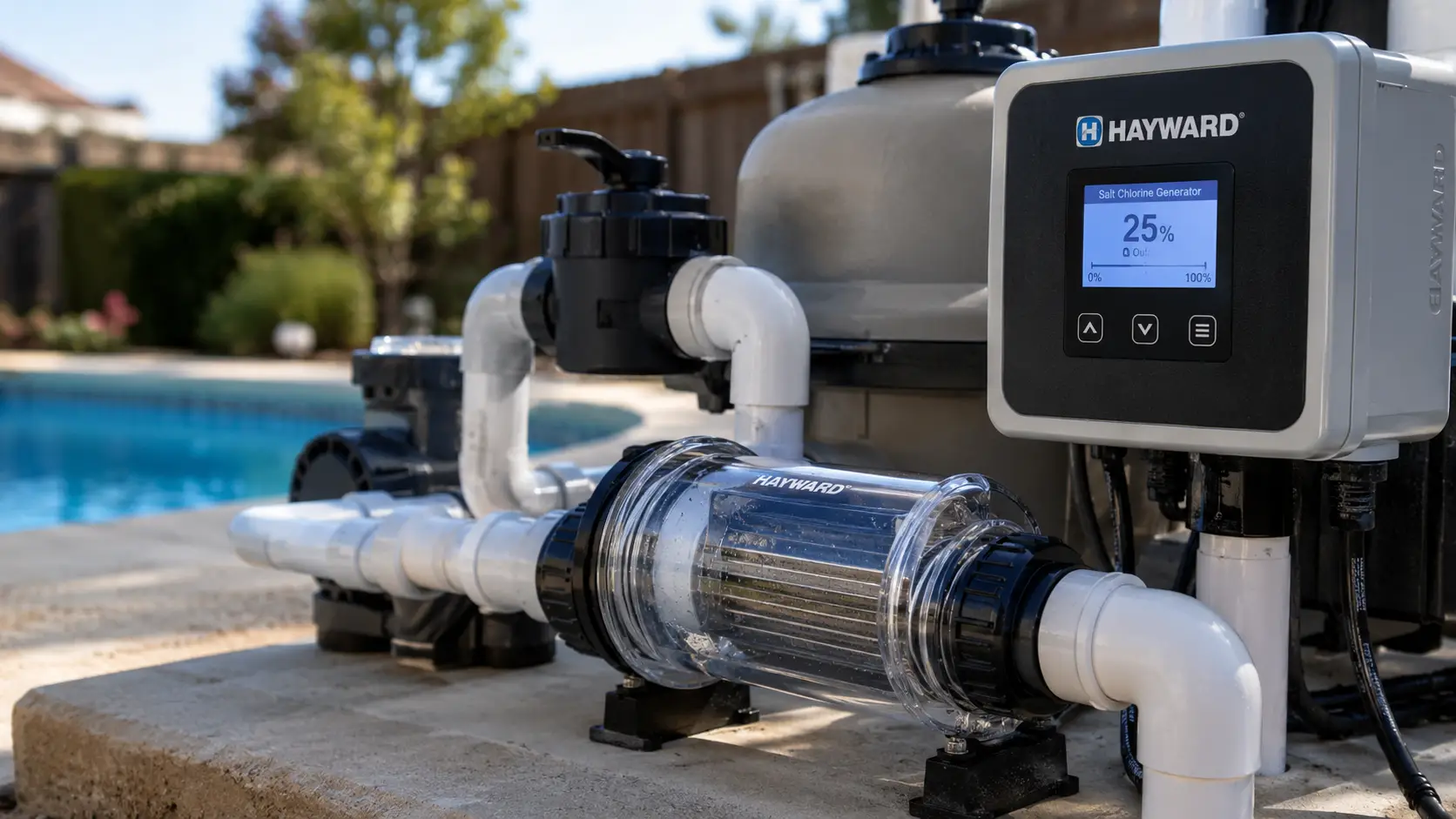
There are three types of pool heaters that make sense in North Texas: gas, heat pumps and solar. Each one fits a different way of using the pool, and the wrong pick shows up fast on your gas or electric bill.
The short version from the equipment pad: gas heats fastest and owns the spa. A heat pump costs about half as much as gas to run through a Dallas swim season, but it slows down when the air turns cold. Solar is close to free once it’s up, if you have the right roof. And a cover saves more money than any of them.
The Three Types of Pool Heaters at a Glance
Most pads in the Metroplex have one of these, and some have two.
| Heater | How it heats | Heat-up speed | Running cost | Best fit in DFW |
|---|---|---|---|---|
| Gas (natural gas or propane) | Burns fuel under a heat exchanger | Fastest | Highest | Spas, weekend heating, cold snaps |
| Heat pump | Moves heat from the air into the water | Slow and steady | About half of gas | Holding temperature April through October |
| Solar | Sends pool water through sun-warmed panels | Slowest, sun only | Close to zero | Extra weeks on each end of summer |
| Electric resistance | Heats water across an electric coil | Slow | Very high | Small spas only |
How a Gas Pool Heater Works
A gas heater burns natural gas or propane in a burner tray. Pool water runs through a heat exchanger above the flame and picks up heat on the way back. The burner chamber can get close to 1,100°F. That’s why gas warms water faster than anything else on the pad.
Gas efficiency is a plain percentage. An 80% heater puts 80 cents of every gas dollar into the water, and the rest goes out the vent. Some newer gas pool heaters reach 89% to 95%. Gas also doesn’t care about the weather. It holds the temperature you set on a 40-degree morning just like it does in May.
The catch is fuel. A big gas heater needs a meter and gas line large enough to feed it. Plenty of homes have a meter sized for a furnace and a water heater. If your street has no natural gas, propane is the fallback, and the tank and delivery price join the bill. Hard North Texas tap water also scales heat exchangers, so keep the water balanced.
How a Pool Heat Pump Works
A heat pump doesn’t burn anything. It works like your home AC running backward. A fan pulls outdoor air across a coil, and the refrigerant inside soaks up its heat. A compressor squeezes the refrigerant hotter, and then it hands that heat to the pool water. You pay to run the compressor and fan, but the heat itself comes from the air.
Engineers rate heat pumps by coefficient of performance, or COP. That’s the heat delivered for each unit of electricity used. The Department of Energy puts most pool heat pumps between COP 3.0 and 7.0, which works out to 300% to 700%. Compare that to 80% to 95% for gas.
That gap doesn’t mean a heat pump costs one-sixth as much to run. Electricity costs more than gas for the same amount of energy, so compare bills, not percentages. There’s another catch, too. The COP on the label comes from a test at 80°F air and 80°F water. A 45-degree March night is a different machine.
Units with scroll compressors put out more heat in cooler air and run quieter. Every heat pump needs its own electrical circuit and open air around it. Keep cottonwood fluff and leaves off the coil, since a blocked coil can’t pull heat.
Gas vs Electric Pool Heater: Heat Pump or Resistance?
When people compare a gas vs electric pool heater, they usually mean a heat pump, since it runs on electricity. A true electric resistance heater is a different animal. It heats water across a hot coil like a big kettle, with a COP of 1. It costs a lot to run and recovers slowly, so it belongs on a small spa. If someone quotes you an “electric heater” for a 15,000-gallon pool, ask which kind.
Pool Heat Pump vs Gas Heater: Speed and Running Cost
Efficiency ratings only get you so far. What most owners want to know is how long they’ll wait and what the bill looks like.
How Long Does It Take to Heat a Pool?
You can do the math on a napkin. A gallon of water weighs 8.33 pounds, and it takes one BTU to warm a pound of water one degree. So every 10,000 gallons needs about 83,300 BTUs for each degree you raise it.
Take a 15,000-gallon pool you want 10 degrees warmer. That’s about 1.25 million BTUs. A 400,000 BTU gas heater at 80% efficiency puts about 320,000 BTUs an hour into the water. So it gets there in roughly four hours. A 100,000 BTU heat pump, a standard size, needs about 12.5 hours at its rated output. And that rating assumes an 80-degree day.
Real pools lose heat while they warm, so add time to both. An uncovered pool on a windy afternoon hands a lot of it right back. Gas suits a Saturday swim you decide on Friday. A heat pump suits a pool you keep warm for weeks.
What It Costs to Hold 80 Degrees in Dallas
DOE publishes season costs for heating a 1,000-square-foot outdoor pool in Dallas from April 1 through October 31. Here’s the 80°F column. The gas figures assume an 80% heater at $1.09 a therm. The heat pump figures assume a COP of 5.0 at about 13 cents a kWh.
| Dallas, Apr 1 to Oct 31, 80°F pool | No cover | With a cover |
|---|---|---|
| Gas heater, 80% efficient | $2,616 | $382 |
| Heat pump, COP 5.0 | $1,321 | $191 |
A heat pump runs about half the cost of gas, and a cover cuts either bill by about 85%.
Source: U.S. Department of Energy, Energy Saver cost tables (1,000 sq ft outdoor pool, Dallas).
Two things jump out. The heat pump runs about half the cost of gas. And the cover cuts either bill by about 85%. Your rates and pool size will move the dollars, so treat this as a comparison, not a quote.
How North Texas Weather Changes the Heat Pump Math
DOE says a heat pump works efficiently while the outside air stays above about 45°F to 50°F. So in Allen or McKinney, the question is how often the air drops below that. Here are the DFW normals for the months people want to stretch, from the National Weather Service.
| Month | Normal high | Normal low | What a heat pump does |
|---|---|---|---|
| March | 68.6°F | 47.8°F | Good in the afternoon, slow overnight |
| April | 76.1°F | 55.2°F | Sweet spot, day and night |
| October | 78.4°F | 57.1°F | Sweet spot, day and night |
| November | 66.6°F | 46.2°F | Good in the afternoon, slow overnight |
April and October are heat pump months. Even the normal low stays above 50, so the unit can hold temperature around the clock. March and November sit right on the line at night. Set the heat pump to run through the warm part of the day, and keep the cover on after dark.
December through February is another story. Normal lows run 36°F to 40°F. DFW also averages 6 to 11 nights a month at or below freezing. A heat pump has little to pull from then. If y’all want to swim in January, that’s gas territory, and the bill will show it. And after February 2021, freeze protection matters with any heater.
Weather swings matter too. When a norther blows through in March, the air can drop into the 40s by evening. South wind is the other local factor. It strips heat off the water all spring, so an open lot needs more heater than a sheltered yard.
Solar Pool Heating in North Texas
Solar pool heating uses your pool pump to push water through panels on the roof or a yard rack. The sun warms the water, and it flows back to the pool. Most home systems use unglazed panels, with no glass cover. A sensor compares panel and pool temperatures. Then a motorized valve sends water up only when the panels have heat to give.
Solar goes first in line. If you also have a heater, the solar adds what it can and the heater makes up the rest. Once it’s installed, the sun doesn’t send a bill. DOE says solar heaters typically outlast gas and heat pumps, too. Our guide to how long pool equipment lasts covers the rest of the pad.
Solar does need pump time. Panels only heat while water moves through them, so the pump has to run through the sunny middle of the day. Our post on how long to run your pool pump covers scheduling.
How Much Panel Area You Need and Which Way It Faces
DOE’s rule of thumb is panel area equal to 50% to 100% of the pool’s surface. Cloudier places sit at the high end. A 16-by-32 pool has 512 square feet of water, so it wants about 256 to 512 square feet of panels. That’s a lot of roof.
Direction matters as much as size. Panels do best facing true south, but DOE says up to 45 degrees east or west still works well. For year-round use, tilt them at your latitude. DFW sits near 33 degrees north, so that means about a 33-degree tilt. For summer-only use, DOE suggests your latitude minus 10 to 15 degrees. A north-facing roof is a non-starter, and so is one under a big live oak.
Sun Hours and Spring Hail in DFW
NWS records put DFW at 58% of possible sunshine in March and 61% in April. October runs 63% and November 57%, while July hits 75%. So solar collects the most when you need it least, but it does honest work in the shoulder months. December and January drop to 52%, with short days and a low sun. Solar won’t carry a January pool.
Then there’s hail. Spring storms roll through the Metroplex every year, and roof panels take whatever falls. Before you buy, ask how the panels handle hail and if your homeowner’s policy covers them. Plan for the next roof replacement too, since the panels and plumbing have to come off and go back on. And the roof penetrations need to be right, or you trade a warm pool for a ceiling stain.
Solar has a summer trick as well. July and August normal highs sit near 96°F, and sunny pools climb into the 90s on their own. Run the panels at night and they shed a little heat to the sky.
Heating an Attached Spa
An attached spa flips the priorities. For a pool you keep warm all season, surface area matters most, since the surface is where heat leaves. For a spa, speed matters most. Most people decide to get in the spa about an hour before they do.
The same napkin math works. A 500-gallon spa going from 65°F to 102°F needs about 154,000 BTUs. That 400,000 BTU gas heater does it in about half an hour on paper. A 100,000 BTU heat pump needs about an hour and a half at rated output. On a 45-degree evening it takes far longer. That’s why gas is the usual pick for an attached spa.
Keep the set point at 104°F or lower, the top of the safe range for spas. A spa cover helps more than people expect, since a spa loses heat through its surface too. If your spa used to heat in under an hour and now takes three, that’s a spa repair call.
The Cheapest Way to Heat a Pool Starts With a Cover
The cheapest way to heat a pool is to stop losing the heat you already paid for. Evaporation causes about half of a pool’s heat loss. Heat radiating to a clear night sky takes another 20% to 30%. Wind across the water takes 15% to 25%, and very little leaves through the walls.
Evaporation costs the most because each pound of 80°F water that evaporates carries off 1,048 BTUs. In a typical pool, losing one inch throws away about as much heat as warming the whole pool 15 degrees. Dry, windy spring days speed that up.
A cover blocks evaporation, radiation and wind at once. DOE says covers can cut pool heating costs by 50% to 70%, and its Dallas table above shows even more. A clear bubble cover still lets most of the sun through. Per DOE, it trims the pool’s solar gain by only 5% to 15%, while an opaque cover trims 20% to 40%. A fence or hedge on the windy side helps too.
If you only buy one heating product this year, buy the cover. It’s not glamorous. Neither is a $2,600 gas season.
Matching the Types of Pool Heaters to How You Swim
Here’s how the types of pool heaters line up with the way people actually swim around DFW:
- Attached spa, or you heat on demand for weekends and parties? Go gas.
- Swimming several times a week from April through October? Get a heat pump and a cover.
- Big south-facing roof and you want extra weeks for almost nothing? Look at solar, often with a heater as backup.
- Want a hot spa on demand and a warm pool all spring and fall? Run both, with gas for the spa and a heat pump for the pool.
- Set on swimming in January? That takes gas, a cover and a realistic budget.
One more opinion from the pad. Buy for the months you’ll actually swim, not the one January weekend you might.
Getting the Right Heater Installed or Fixed
Picking a type is half the job. The other half is sizing it right and checking the gas meter or electrical panel before anyone plumbs it in. Our pool heater installation team handles gas, heat pumps and solar in Allen, Plano, Frisco and across North Texas.
Already have a heater that flashes a code or blows cold? Start with pool heater repair. A lot of heater trouble turns out to be low flow from a dirty filter, not a dead heater. Want to fire up the spa from your phone on the drive home? Pool automation lets you set the heater and switch to spa mode from an app.
Call (214) 922-1914 or schedule service online, and we’ll look at your pad and tell you what fits.
Pool Heater Questions From North Texas Pool Owners
Straight answers to what DFW pool owners ask most about heating.
What type of pool heater is most efficient?
A heat pump is the most efficient type by the numbers. DOE puts pool heat pumps at a COP of 3.0 to 7.0, or 300% to 700%, while gas heaters run about 80% to 95%. Solar uses free sunshine but can't heat on demand. In DOE's Dallas example, a heat pump cost about half as much as gas to hold 80°F for the season.
Which is better, a heat pump or gas heater for a pool?
It depends on how you swim. Gas heats fastest, works in any weather and is the usual pick for an attached spa or weekend heating. A heat pump costs about half as much to run through a Dallas season, but it slows down once the air drops below about 45°F to 50°F. Pools with a spa and a long swim season can run both.
Is solar heating for a pool worth it?
It's worth it if you have a south-facing roof with room for panels equal to half or more of your pool's surface. Then you get extra weeks at almost no running cost. It won't heat a spa on short notice or carry a January pool, since DFW sunshine drops to 52% of possible in winter. Ask about hail first, and plan for pulling the panels when the roof gets replaced.
What is the cheapest way to heat a pool?
Start with a cover. DOE says a cover can cut heating costs by 50% to 70%, and in its Dallas example it cut the season cost by about 85%. After that, solar has almost no running cost, and a heat pump runs about half the cost of gas.
How long does it take a heat pump to heat a 10,000 gallon pool?
Plan on about eight hours of run time for a 10-degree rise, plus extra for heat loss. Each 10,000 gallons needs about 83,300 BTUs per degree. So a 100,000 BTU heat pump adds roughly 1.2 degrees an hour at rated output. That rating assumes 80°F air, so it takes longer on a cool March evening or with the pool uncovered.
Is a heat pump even an option in North Texas?
Yes, for most of the swim season. DOE says heat pumps work efficiently above about 45°F to 50°F. DFW's normal lows in April and October stay in the mid-50s, while March and November sit right at the line overnight. From December through February, with normal lows of 36°F to 40°F, gas does the job better.
Can you swim in a heated pool when it's in the 60s and low 70s?
Yes, if the heater fits the job and you use a cover. March and November highs at DFW average in the high 60s. A heat pump still works through those afternoons, and gas works any time. Wind and clear nights pull heat out fast, so keep the cover on whenever nobody's swimming.
Should I get a heat pump, a gas heater, or both?
Get both if you have an attached spa and want a warm pool all spring and fall. The heat pump holds the pool at temperature for less money. Gas heats a 500-gallon spa in about half an hour and covers cold snaps. If you add solar, it goes first in line and the heater makes up the rest.
How hot does a North Texas pool get in July and August?
Hot enough that nobody runs a heater. DFW's normal highs sit near 96°F in July and August, and sunny pools climb into the 90s on their own. If yours turns into bathwater, running solar panels at night sheds a little heat to the sky.
Will I need a bigger gas meter for a pool heater?
Possibly, so check before you buy. A large gas pool heater needs a meter and gas line big enough to feed it. Plenty of homes have a meter sized for a furnace and a water heater. A heat pump skips the gas question but needs its own electrical circuit.