Pool plaster colors decide what your water looks like once the pool is full, more than any chemical does. A white finish gives you pale aqua water. Go gray and the water turns a truer blue, and a dark finish pushes it toward a deep lagoon.
Around DFW, that finish also has to survive triple-digit summers and hard fill water. The color on the sample board is day one. What it looks like in year five depends on the finish you pick and how well the water is kept.
How Pool Plaster Colors Set Your Pool Water Color
Water in a glass looks clear. In a pool it looks blue because water soaks up the red end of sunlight. What’s left is the blue part, which is also why the ocean looks blue. The finish under that water is the backdrop. A light finish bounces most of the light back, so you see bright, pale water. A dark finish soaks more of it up, so the same water looks deeper.
Depth changes the shade too. The shallow end and a tanning ledge always look lighter than the deep end, even on one finish. Shade from a big live oak darkens the water, and the color shifts again from morning to late afternoon. That’s why a dry sample chip in your hand is a rough guide at best. Look at samples wet and in the sun. If you can, stand next to a finished pool in that color.
White Plaster Pool: Light Aqua Water
A white plaster pool gives you the lightest water you can get, a pale aqua that reads clean and bright. Finish maker SGM notes that white plaster also makes a pool look bigger and the water look clearer. The trade-off is that white shows everything. Leaf stains and dirt on the floor stand out on white long before you’d notice them on gray.
Gray Pool Plaster: True Blue Water
Gray pool plaster is the middle road. Light gray gives a soft sky blue, and darker grays push the water toward a medium blue. If blue water is the goal, finish makers point you to white, blue or gray pigments. Gray also hides a little dirt between brushings, which helps on a pool under trees.
Dark Blue and Black Finishes: Deep Lagoon Water
Dark finishes turn the water deep navy or a dark lagoon blue, depending on the pigment. They look sharp with a clean rectangle and simple tile. The catch is upkeep you can see. White calcium scale stands out on a dark floor. It’s also harder to spot a dropped toy (or a snake) on the bottom.
Pool Finish Colors and the Water They Make
Sun, depth and shade still move these around, but this is the usual result:
| Finish color | Water color you’ll see | Good to know |
|---|---|---|
| White | Pale aqua, the lightest water | Shows stains and dirt first |
| Light gray | Soft sky blue | Hides light dirt better than white |
| Blue gray or medium gray | Medium blue | A true blue look in full sun |
| Dark blue or black | Deep navy or lagoon | Shows white scale; floor is harder to see |
| Tan, brown or gold | Water that leans green | Skip these if you want blue water |
Finish Types: Standard Plaster, Quartz, Pebble and Polished
Pool plaster colors are only half the choice. The material decides how the finish feels and how long it holds its color.
Standard plaster, which older techs still call marcite, is white cement and marble dust troweled smooth over the gunite shell. It’s the smoothest finish under your feet, and it’s the budget option. Colored plaster is the same mix with pigment added. It also fades first.
Quartz finishes blend quartz crystals into colored cement. They feel close to plaster, and SGM rates colored quartz best of the group at holding color under UV. Pebble finishes set small stones in a cement binder and leave them exposed. You get the longest life and a bumpier feel. Polished aggregate is a stone finish ground smooth, so the stone shows but the surface feels smoother than standard pebble.
All of these are cement-based. That means the same water balance rules apply to every one of them, pebble included. One finish maker, SGM, puts plain plaster at about 5 to 10 years. It rates colored quartz at 12 to 18 years and pebble at 15 to 20, with proper care. Water balance decides where your pool lands in that range.
Pebble Tec vs Plaster
People say Pebble Tec for any pebble finish, the way they say Kleenex for tissue. Pebble costs more up front and lasts longer, and it holds color better than plaster. Plaster is smoother and cheaper, but it needs redoing sooner and shows etching and staining sooner too. If your kids live on the steps all summer, smooth plaster or quartz is kinder to feet. If you want the longest gap between remodels, pebble earns its price. For a lot of DFW families, quartz is the sensible middle.
Why Pool Plaster Colors Fade and Stain in North Texas
Plaster is mostly calcium carbonate, the same mineral as limestone. Your water is always trying to either dissolve it or coat it, and both show up as color problems.
Hard Water and Summer Heat
Water that runs low on pH, alkalinity or calcium is corrosive, and it can etch plaster in a short time. Etched plaster turns rough and dull, and on a colored finish it looks blotchy. Push the other way, with high pH and high calcium, and the water drops scale. Scale is a crusty white deposit that picks up dirt and turns grayish.
North Texas makes the second problem the common one, because fill water across the Metroplex is hard. Every inch you lose to evaporation in July leaves its calcium behind, and the top-off adds more. Heat makes it worse, because calcium gets less soluble as water warms. So water that tested fine in April can start scaling by August. For plaster, keep calcium hardness at 200 to 400 ppm and the saturation index between minus 0.3 and plus 0.3.
Color fades too. UV ages every finish, colored plaster fades over time, and long summers of direct sun speed that up here. Some blotchiness, called mottling, starts at the very beginning, since a new finish is at its most fragile in its first 28 days.
Metal and Leaf Stains
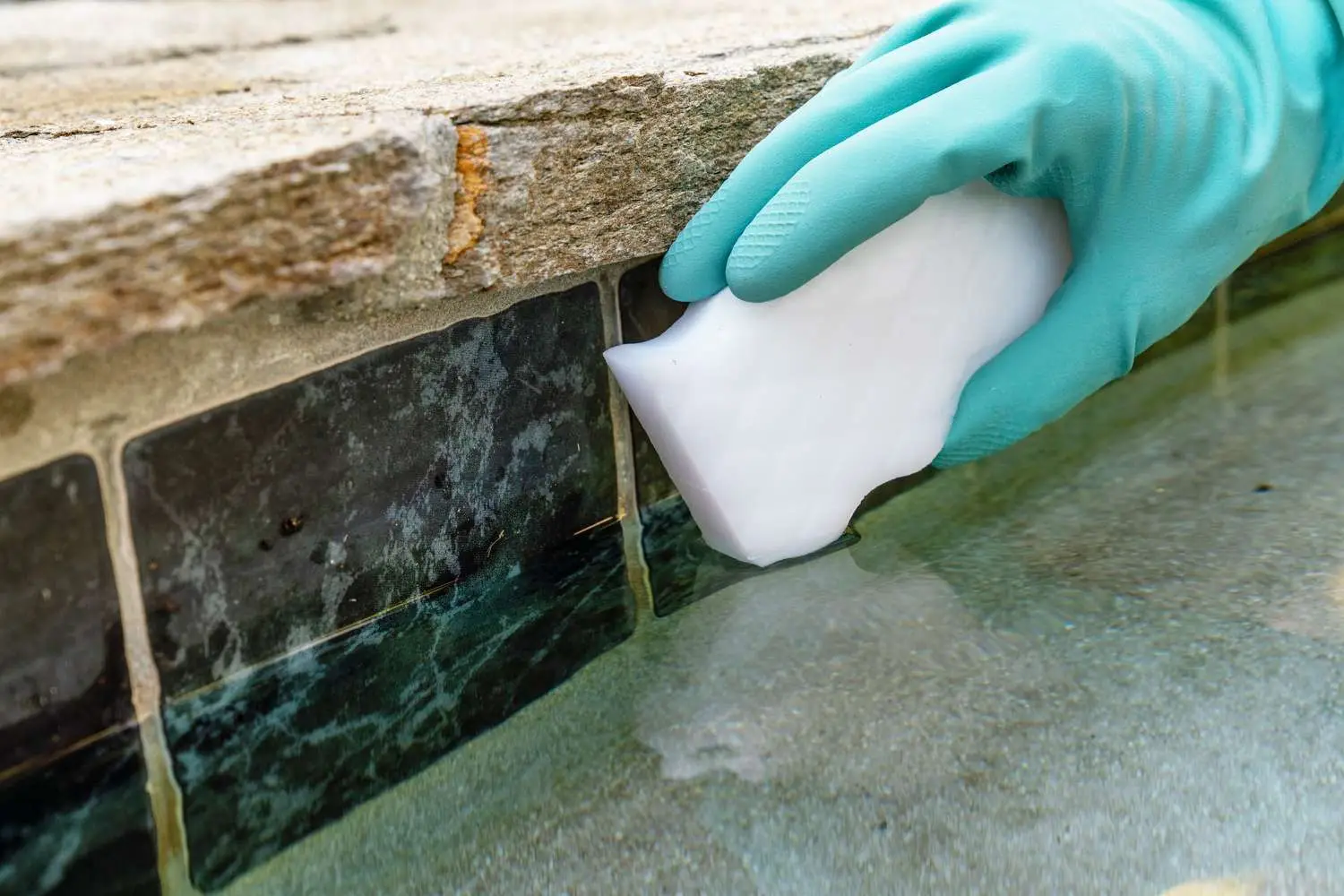
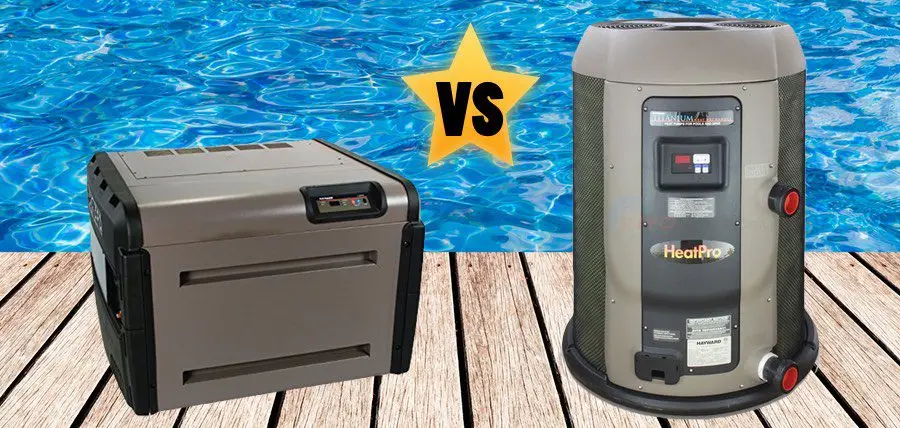
Most heaters have copper in the heat exchanger, and when pH runs low the water dissolves it and leaves blue-green stains on the plaster. Iron from stainless fixtures or the fill water leaves reddish brown stains. If copper meets high stabilizer (CYA), it can even stain plaster purple.
Leaves leave their own marks. Live oak and cedar elm leaves that sit on the floor leave dark tannin stains. In spring, oak pollen and cottonwood fluff settle into every corner too. Tannin stains often bleach out with chlorine. Metal stains don’t, and they come back unless you fix the source. Either kind gets harder to remove the longer it sits.
Do Dark Finishes Make the Water Warmer?
A little, yes. Dark surfaces absorb more sun than light ones. It’s the same reason a light-colored roof stays cooler than a dark one. Lighter finishes also stay cooler underfoot, which you’ll notice on the steps in July.
How much warmer is where people argue. Dallas-area owners on pool forums report anything from almost no difference to several degrees. One noticed it mostly in water under a foot deep. In a Plano August, every pool runs warm anyway. So the extra warmth from a dark finish pays off more in April and October.
Commercial pools play by other rules. Public pool inspection checklists commonly call for a white or off-white shell. That keeps the main drain visible from the deck. Managing an HOA or apartment pool? Check your code before picking a dark finish. We handle commercial pool services for HOAs, apartments and hotels too.
The Minimalist Look: Finish Color That Photographs Well
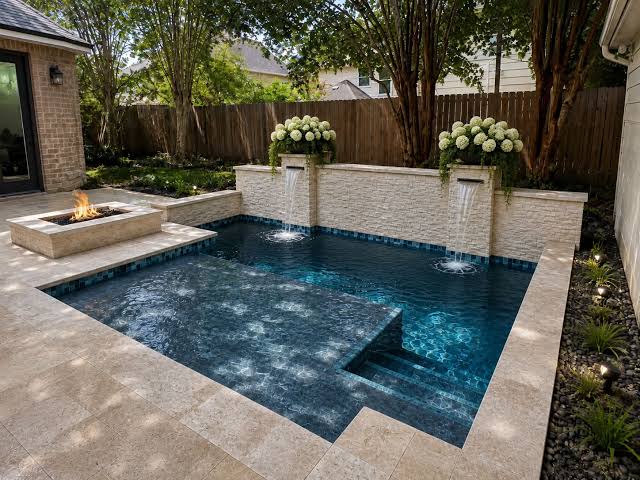
A minimalist pool design leans on very little: a clean rectangle, one tile band, plain coping and a quiet finish. White or light gray finishes give that glassy, pale water. A dark blue finish does the opposite and turns the pool into a mirror for the sky.
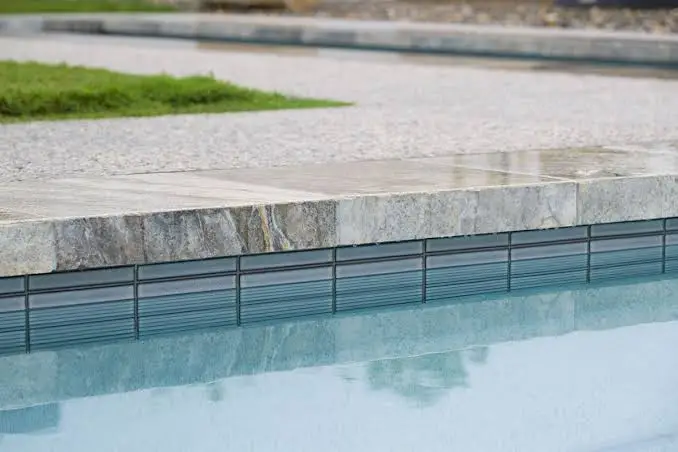
If you want the pool to look good in photos, shoot it in full sun. Water color shifts from early morning to late afternoon, and shade darkens it. Tile matters as much as the finish, since it sits right on the waterline. We cover that side in our post on pool tile ideas.
New Plaster Start-Up: The First 28 Days
A new finish isn’t done when the hose goes in. Most of the curing, which the trade calls hydration, happens in the first 28 days. That’s when plaster is most likely to stain, scale or discolor. Mistakes in that window can show up for years as blotches and streaks.
Filling the Pool
Fill without stopping, as fast as you can, with clean tap water. A rag on the hose end, laid in the deep end, keeps the hose from marking the surface. Stopping partway can leave a ring, and water from sprinklers or a downspout can streak the finish. Keep people and pets out during the fill. Then test the fill water for pH, alkalinity, calcium and metals before you add anything.
Days 1 Through 3
Start the filter as soon as the water reaches the skimmers, and run it nonstop for at least 72 hours. On day 1, set alkalinity to 80 ppm first. Then bring pH to 7.2 to 7.6 and calcium to at least 150 ppm. A metal sequestrant that day is good insurance against stains. Brush the whole pool at least twice a day to get the plaster dust off. Hold the chlorine for the first 48 hours. On day 3, add enough to reach 1.5 to 3 ppm. Leave the heater off until the dust is gone.
Days 4 Through 28
After day 3, keep testing and balancing every day for 14 more days, which takes you through day 17. On day 7, use a brush vacuum to pick up any dust that’s left. From day 4 on, raise calcium slowly over the rest of the month, but don’t go past 200 ppm. Bring stabilizer up to 30 to 50 ppm after day 4 as well. Hold off on salt for 28 days, even on a salt pool. Keep robotic and other wheeled cleaners out until day 28 too.
The Start-Up Timeline at a Glance
The daily work runs about two and a half weeks, but salt and wheeled cleaners wait the full 28 days.
Source: industry operating guidelines for new plaster start-up.
| Start-up step | When | Detail |
|---|---|---|
| Hold off on chlorine | Days 0 to 2 | Chlorine to 1.5 to 3 ppm on day 3 |
| Run the filter nonstop | Days 0 to 3 | At least 72 hours |
| Brush twice a day | Days 1 to 3 | Longer if dust remains |
| Test and balance daily | Days 1 to 17 | Alkalinity, then pH, then calcium |
| Raise calcium slowly | Days 4 to 28 | 200 ppm max |
| No salt added | Days 0 to 28 | Salt pools too |
| No wheeled cleaners | Days 0 to 28 | Robots stay out |
Handing Off the Start-Up
That’s a lot of daily work for someone with a day job. We recommend brushing twice a day through the whole first week. We also offer a new-plaster start-up service, so contact us once your plaster date is on the calendar. After day 28, regular weekly pool service keeps the balance steady. You get a digital report with chemical readings after every visit.
Acid Wash vs Replaster: Fixing a Faded or Stained Finish
An acid wash and a replaster solve different problems. A controlled acid wash dissolves a thin layer of plaster, and the stains in that layer go with it. It works on mineral stains, calcium scale and old algae marks when the plaster underneath is still sound. It can’t put color back into faded plaster, though. Colored and pebble finishes don’t always come back evenly after a wash either.
Each wash also takes some plaster with it, so a pool can only take so many. If the finish is pitted, chalky, flaking or worn through to the gray base coat, acid makes it look worse. That pool needs a replaster.
Draining is the risky part of either job. After a wet spring on Blackland Prairie clay, groundwater can push hard enough to float an empty shell. Plaster left empty in 100°F sun can also dry out and crack. So check the hydrostatic relief valve and watch the forecast before anyone pulls the plug.
If the stain sits in the surface and the plaster is healthy, our acid wash service is the smaller job. And if it’s only leaf stains, try chlorine and a brush first, because you may not need either one.
Choosing Pool Plaster Colors for Your Remodel
When it’s time for a new finish, picking the color is the fun part. On our pool remodeling jobs we install Jewel Scapes, Quartz Scapes and Stone Scapes finishes. Water colors include Blue Gray, Dark Blue and Light Gray. You see samples before any work starts, so you aren’t guessing from a photo on your phone.
Tell us how your pool sits, in full sun or under live oaks, and who uses it most. That narrows the list fast. Call (214) 922-1914 or schedule service online. We work on pools in Allen, Plano, Frisco, McKinney and across North Texas.
Pool Plaster Color Questions From North Texas Pool Owners
Quick answers to common questions about pool plaster colors from DFW pool owners.
What is the best color for pool plaster?
There isn't one best color, only the best match for the water you want. White gives the lightest aqua water, gray gives a truer blue, and dark blue or black gives a deep lagoon look. Under North Texas trees, light gray hides dirt better than white.
Does a white plaster pool look blue?
Yes, a white plaster pool looks pale aqua blue once it's full. Water soaks up the red part of sunlight, so even over a white floor you see blue. It's just a bright, light version. The shallow end will always look lighter than the deep end.
What colors should you avoid for pool plaster?
Avoid tan, brown and gold pigments if you want blue water, because they push the water toward green. Very dark finishes aren't wrong, but they show white calcium scale and make the floor harder to see. HOA and other commercial pools should check the code first, since public pools often need a white shell.
Does colored pool plaster fade?
Yes, colored plaster fades over time, and long North Texas summers of direct sun speed it up. UV ages every finish, but colored quartz holds its color best and pebble holds color better than plaster. Poor water balance adds etching and mottling on top of the fading.
Does Pebble Tec last longer than plaster?
Yes, pebble finishes usually outlast plaster by years. One finish maker, SGM, rates plain plaster at about 5 to 10 years and pebble at about 15 to 20. Colored quartz falls between them at 12 to 18. Your water balance decides where your pool lands in that range.
Will a light blue or gray finish make my pool warmer in a DFW summer?
A little, but it's hard to notice in midsummer. Darker finishes absorb more sun, so the water can run warmer. Owners who notice it mostly feel it in shallow water. In an Allen or Plano August every pool runs warm anyway, so the extra heat matters more in spring and fall.
Should I go with a black finish for a dark lagoon look?
Go for it if you love the look and can live with the upkeep you'll see. A black or dark blue finish turns the water deep navy or lagoon. White calcium scale stands out on it, though, and the floor is harder to see. Keep pH and calcium in range so scale doesn't form, and expect the water to run a bit warmer.
My builder wants to handle the chemistry after new plaster. Is that worth it?
Yes, for the first 28 days at least, since that's when new plaster stains and scales most easily. It needs daily testing through about day 17 and twice-daily brushing at the start, then regular weekly care after day 28. If your builder doesn't offer it, our new-plaster start-up service can take it off your hands.
Is pebble the best surface for a DFW pool remodel?
Pebble lasts the longest, but it costs more and it's rough on feet. Plaster is the budget option and the smoothest finish. Quartz sits between them on life span and feels close to plaster. For a pool full of kids every summer, quartz is usually the better fit.
Why did my white plaster turn blue-green near the heater?
That's usually copper from the heater. Most heaters have copper in the heat exchanger. Water with low pH dissolves it and leaves blue-green stains on the plaster. Fix the pH and find the source first, because metal stains come back if the copper keeps coming.