The sand vs cartridge filter question has a third answer, DE, and the right pick depends on two things. How fine do you want the water filtered, and which chore would you rather do? All three types of pool filters keep a pool clear when they’re sized right and cleaned on the pressure gauge.
Short version: DE filters the finest, a cartridge wastes the least water, and sand is the simplest to clean. The rest is the detail behind that, plus what oak pollen, cottonwood and triple-digit summers do to each one.
Sand vs Cartridge Filter vs DE: The Short Answer
| Filter | Traps particles down to | How you clean it | Backwash water | Best fit |
|---|---|---|---|---|
| Sand | About 25 microns | Backwash at 8 to 10 psi over clean | Yes, every cleaning | Least hands-on work, pads with a good drain spot |
| Cartridge | About 10 microns | Pull and hose off at about 10 psi over clean | None | Tight pads, water savers, spas |
| DE | About 2 microns | Backwash, add fresh DE, soak the grids now and then | Yes, plus spent powder | Owners who want the clearest water |
There’s no single best type of pool filter, just the best fit for your pad and your patience. Sand gets a bad rap, mostly from owners who backwash it every weekend, yet it’s fine if your pad has a good drain spot. If you’d rather not dump pool water, or the pad is tight, a large cartridge is the easy pick. DE makes sense when you want the most polished water and don’t mind handling powder.
How the Three Types of Pool Filters Work
Sand Filters
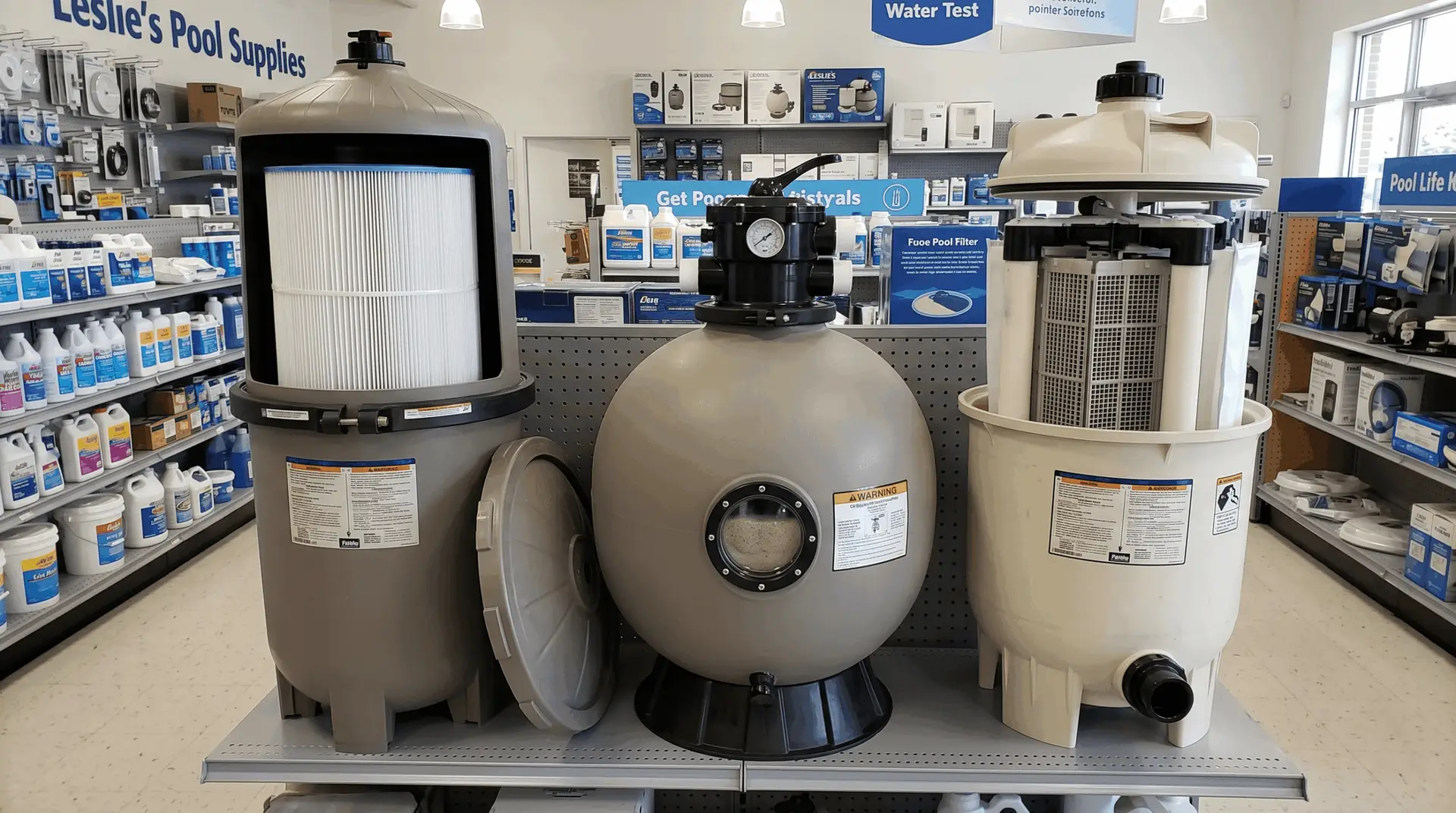
Water enters the top of the tank and passes down through a bed of #20 silica sand. Dirt lodges in the gaps between the sharp-edged grains. As those gaps fill, the bed catches smaller and smaller particles. Right after a backwash, a sand filter mostly traps dirt above 50 microns. Late in the cycle, it gets down to about 25 microns. That’s why you backwash on pressure and not on the calendar.
Cartridge Filters
A cartridge is a pleated sleeve of spun polyester wrapped around a core. Dirt collects on the surface of the fabric, and it traps particles in the 10 to 25 micron range. The pleats pack a lot of filter area into a small housing, so a cartridge needs about half the pad space of a sand or DE filter. The catch is that cartridges hate high flow. Push water through too fast and oils end up so deep in the fabric that hosing won’t get them out.
DE Filters
DE is short for diatomaceous earth, a white powder made from the fossil shells of tiny sea plankton called diatoms. Inside the tank sit fabric-covered grids. Water flow holds a thin cake of DE against the fabric, about 1/16 to 1/8 inch thick. That cake does the filtering, down to 2 to 6 microns. Since flow holds the cake on, the powder drops off when the pump stops and recoats the grids at startup. DE is a throwaway media, too. Each backwash flushes it out, and you add fresh powder.
What Size Dirt Each Pool Filter Catches
Filter makers rate fineness in microns. A micron is one millionth of a meter, and about 25 of them fit in a thousandth of an inch. For scale, a grain of table salt is about 100 microns across and a human hair about 70. Most people can’t see anything smaller than about 40.
DE catches the finest dirt, cartridges sit in the middle and sand is the coarsest, but all three trap specks smaller than the eye can see.
Source: industry operating guidelines for pool filter media.
| Filter type | Particle range trapped |
|---|---|
| Sand | 25 to 100 microns |
| Cartridge | 10 to 25 microns |
| DE | 2 to 6 microns |
| Naked-eye limit (reference) | about 40 microns |
Finer isn’t the whole story, though. Clear water takes filtration, circulation and chemistry working together. A DE filter can’t rescue a pool with no chlorine in it. If the water stays hazy no matter which filter you run, start with our guide to cloudy pool water.
Flow Rate Per Square Foot: Why Cartridge Filters Look So Big
Every filter media has a safe speed, measured in gallons per minute (gpm) per square foot of media. The design rates look like this:
- High-rate sand: 5 to 20 gpm per square foot, with 15 the usual design number
- DE: about 2 gpm per square foot
- Cartridge: 0.375 to 1 gpm per square foot
So say your pump moves 60 gallons a minute. Using 15 for sand, that flow needs 4 square feet of sand, 30 square feet of DE grid or 60 to 160 square feet of cartridge. Only the top of a sand bed counts as filter area, so a backyard sand tank has just a few square feet. That’s why cartridge labels read in the hundreds. A filter with more area than the minimum also holds more dirt between cleanings.
Going over those rates causes trouble on every type. Sand gets dirt driven deep into the bed, and water channels past it unfiltered. A cartridge gets oils embedded so deep they won’t rinse out. With DE, the powder gets pressed into the grid cloth and shortens grid life. Flow is one reason pump speed matters to your filter, and our post on how long to run a pool pump covers that side.
How to Clean a Sand vs Cartridge Filter (and a DE)
All three filters tell you when they’re dirty the same way. As the media loads up, the pressure gauge climbs and flow drops. Write down the clean pressure after every cleaning, because that number is your baseline.
Backwashing a Sand Filter
Backwash when the gauge reads about 8 to 10 psi over the clean starting pressure. Turn the pump off before you move the multiport handle, every time. A pressure filter can come apart violently if you switch it under pressure. Backwashing reverses the flow, lifts the sand bed and flushes the dirt out the waste line. Run it until the sight glass shows clear water.
Most people backwash too often. A bed that’s a little dirty filters finer, so a weekly backwash throws away the fine filtering you were waiting for. Go easy on floc and other filter aids, too. They help in the short term, but over time they can glue the sand into one mass that filters poorly.
Cleaning a Cartridge Filter
A cartridge never gets backwashed. When pressure runs about 10 psi over clean, shut the pump off and bleed the air. Then pull the element and hose it off. If oils or scale have built up, soak it in a filter cleaner. Degrease first and use an acid cleaner second, since acid on an oily cartridge sets the oil into the fabric. Check and lube the lid O-ring while it’s open, because a dry one leaks or sucks in air. A spare set of cartridges makes the job easy, since the dirty set can soak while the clean one runs.
Backwashing and Recharging a DE Filter
A DE filter backwashes like sand at about 8 to 10 psi over clean, but the powder goes out with the dirt. Then you mix fresh DE into a bucket of water and feed it in with the pump running, usually through the skimmer. The usual dose is about 2 ounces per square foot of filter area. A 48-square-foot filter takes about 6 pounds, but the maker’s label wins. Too little powder leaves bare spots, so the water won’t polish and oils clog the cloth until the grids get damaged. Too much and the cakes on neighboring grids grow together, which techs call bridging.
A hard-working DE filter also needs a full teardown and grid soak about every three months of run time. A lightly used backyard pool can often go longer. If pressure stays high right after a backwash, though, it’s teardown time.
How Much Water Each Filter Sends Down the Drain
Every backwash dumps pool water to waste, and sand and DE filters backwash at every cleaning. A cartridge doesn’t backwash at all. When Austin Water’s pool filter rebate paid owners to switch, it figured a cartridge uses one-twelfth the water. That works out to about 2,000 to 8,000 gallons a year saved in backwash.
There’s a flip side the cartridge crowd rarely mentions. Backwashing also swaps a little old water for fresh, and that small dilution keeps dissolved minerals in check. North Texas tap water is already hard, and triple-digit summers evaporate water and leave the calcium behind. A cartridge pool misses that steady exchange, so it may need a partial drain and refill sooner.
Then think about where the backwash goes. It needs a spot that drains away from the house and the neighbor’s fence. On Blackland Prairie clay, a soggy side yard can stay soggy for days. If your pad has no good drain spot, that alone can make the call for a cartridge.
How Often Each Filter Needs Attention in North Texas
The gauge sets the schedule, and the Metroplex keeps it busy. Oak pollen coats pools in spring, cottonwood fluff follows, and live oaks drop their old leaves around the same time. When a norther blows through in fall, cedar elm leaves land in the pool. Storms and hail add grit, and a dry, gusty day can dust a pool in an afternoon. Then summer brings more swimmers and a steady load of sunscreen and body oil. Each filter type handles that load a little differently.
- Sand shrugs off heavy loads and only needs a backwash, but its coarser bed lets more of the finest particles through.
- A big cartridge holds plenty of dirt, but pollen weeks can push the pressure up fast, and oily summer water mats the pleats.
- DE catches the most, so it can load up the fastest. In heavy pollen or after a dust storm, check a DE gauge every few days.
If any filter clogs far faster than it should, look in the skimmer. Chlorine tablets there feed chemicals ahead of the filter, and that shortens filter runs. When you’d rather hand off the messy part, our filter cleaning service handles all three types.
Which Filter Suits Which Pool
Sand Filter vs Cartridge Filter
Pick sand if you want the simplest routine and your pad drains well. Pick a cartridge for finer filtering and less water down the drain, especially on a tight pad. Cartridges are also the usual choice for spas. The tradeoff is hands-on cleaning and buying new elements now and then.
DE vs Cartridge Filter
Both filter finer than sand. DE wins on clarity, and a cartridge wins on simplicity and water use. DE also means buying powder and disposing of the spent stuff safely. If sparkle matters most, DE is worth the routine. If not, a large cartridge gets you most of the way there.
DE Filter vs Sand Filter
Both backwash, so neither one saves water. DE filters far finer, but it adds a recharge after every backwash and a grid teardown now and then. Sand is the low-effort option, and the media lasts for years. If you want finer water without the powder, a cartridge is the middle ground.
Handling DE Powder Safely
DE needs more care than the other two media. Get the Safety Data Sheet for the brand you buy and read it. Dry DE is a fine, sharp dust that can contain crystalline silica, which OSHA ties to silicosis and lung cancer. Wear a dust mask when you pour it. Wetting it in a bucket first keeps it from puffing into the air.
Store the bag away from the pump, since airborne DE can get into the motor windings and wear the motor out early. Keep it away from pool chemicals and test kit reagents, too. Never wash spent DE into the street, a storm drain or a creek, and check your city’s disposal rules. Some owners use a wood-fiber substitute that breaks down naturally, but read your filter’s manual before you switch.
When the Filter Media Wears Out
Filter Sand
Filter sand lasts about 5 to 15 years. New sand has sharp edges that grab dirt, while old sand wears smooth and stops holding it. Oils stick to fine particles and form mudballs, and the bed stops filtering evenly. If pressure climbs right after a backwash or the water never quite polishes, the bed needs a chemical soak or new sand. Our sand changes service puts in the right sand at the right depth, with room for the bed to lift during a backwash.
Cartridges
Cartridge elements are replaceable media. Commercial elements are figured at about six months of hard service, and a backyard cartridge sees far less load. Replace an element when it tears or the pleats mat flat. Also replace it when pressure jumps back up right after a good cleaning, because that means dirt is embedded too deep to come out.
DE Grids
Grids last as long as the cloth holds up, so look for tears at every teardown. DE puffing back into the pool usually means a torn grid or a damaged part inside the tank. That’s a job for pool filter repair. Running more flow than the grids are rated for shortens their life. For the tank, valve and the rest of the pad, our guide to how long pool equipment lasts covers the repair-or-replace call.
Thinking About Switching Filter Types?
Switching from sand or DE to a cartridge, or the other way, usually happens when an old filter fails. The new filter has to match your pump’s flow, and the ports don’t always line up with the old plumbing. Our pool filter installation crew sizes the new filter to your pump, plumbs it in, primes it and pressure tests it. Want to skip filter chores entirely? The Full Service plan in our weekly pool service includes filter cleanings twice a year. Call (214) 922-1914, Monday through Friday from 8 AM to 5 PM, or get an instant pool quote.
Sand vs Cartridge Filter Questions From North Texas Pool Owners
Straight answers to what pool owners in Allen, Plano, Frisco and the rest of DFW ask most.
Is a sand filter better than a cartridge filter for a pool?
Neither one wins across the board. A cartridge filters finer, about 10 to 25 microns against 25 to 100 for sand, and it sends almost no water to waste. Sand is simpler, since you only backwash it. A big cartridge suits tight pads and water savers, and sand suits owners with a good backwash drain.
What are the disadvantages of a sand filter?
Sand filters the coarsest of the three types, in roughly the 25 to 100 micron range. Every backwash dumps pool water, so you need a place for it to drain. The bed also wears smooth and builds mudballs over time, so the sand needs changing every 5 to 15 years.
What are the disadvantages of cartridge filters?
You have to pull the element and hose it off by hand, and an oily or scaled cartridge needs a soak. Cartridges are also the filter most sensitive to high flow, which can drive dirt in too deep to come out. Plus, you lose the small water exchange that backwashing gives, which matters with hard North Texas tap water.
Do you backwash with a cartridge filter?
No, a cartridge never gets backwashed. When the gauge reads about 10 psi over its clean pressure, shut the pump off and bleed the air. Then pull the element and hose it off, which is why cartridges send almost no water to waste.
What happens if you run a DE filter without DE?
The bare grid cloth catches oils and fine dirt directly, and they clog the fabric fast. Pressure climbs, the water won't polish, and the grids can end up damaged. Always recharge after a backwash, at about 2 ounces of DE per square foot of filter area unless your filter's label says otherwise.
Can my cartridge filter cleaning wait until it warms up?
Usually, yes, as long as the gauge sits below about 10 psi over the clean reading. Once it passes that mark, flow drops off. So in Prosper, McKinney or anywhere else up here, pick the first mild afternoon instead of waiting for spring.
Is a bigger DE filter worth the extra money?
In most cases, yes. More grid area means each square foot sees less flow, which keeps you under the roughly 2 gpm per square foot DE needs. That also keeps powder from getting pressed into the cloth. A bigger filter holds more dirt, too, so it goes longer between backwashes in pollen season.
Can a DE filter really get that dirty in six weeks?
Yes. DE traps the finest particles of any pool filter, so a heavy pollen spring or a dusty, windy stretch can load it up quickly. Backwash at about 8 to 10 psi over the clean reading. If pressure stays high right after a backwash, the grids need a full teardown and soak.
How many square feet of cartridge filter do I need?
Divide your pump's top flow by the cartridge's rated flow, which runs 0.375 to 1 gpm per square foot. A pump moving 60 gallons a minute needs somewhere between 60 and 160 square feet. Going bigger than the minimum means more dirt capacity and fewer cleanings, which helps under North Texas oaks.
Is sand or a cartridge easier to live with?
Sand takes less hands-on work, since a backwash means turning a valve and watching the sight glass. A cartridge saves the backwash water but has to come out and get hosed off. If dumping water bugs you more, get the cartridge, and if pulling elements bugs you more, stay with sand.