
Pool Filter Cleaning in North Texas
Southern Pool + Outdoors handles pool filter cleaning across North Texas. We take apart cartridge, DE and sand filters, clean the media, check every seal and gauge, then restart the system at the right pressure. Call (214) 922-1914.

Pressure creeping up or water looking dull? Get a free pool filter cleaning quote from Southern Pool + Outdoors.
Schedule Service!
Your Filter Does the Heavy Lifting
Chlorine kills what lives in your water, but it doesn’t remove anything. The filter does that part. Every hour the pump runs, your water goes through the filter media. That media traps the dirt, pollen, dead algae, body oils and fine dust that make a pool look flat and hazy. When that media clogs, the pump pushes against a wall, flow drops, and your chemicals end up fighting everything the filter should have caught.
North Texas pools load filters fast. Spring oak pollen, dust blown in on south winds, fall leaves and hard water all end up in the media. Sunscreen and body oils coat cartridge pleats and DE grids, and calcium hardens on top of the oil. A quick hose-off knocks loose dirt away but leaves that oily, scaly layer in place. That’s why pressure often climbs right back up a few days later. Leave it long enough and the pump runs hot and the heater sees less flow. You also start buying extra chlorine for water that never gets truly clean.
Pool filter cleaning from Southern Pool + Outdoors goes deeper. We take the filter apart and clean the media for what’s actually on it. Then we inspect the parts that fail and restart the system so the gauge reads where it should. We clean all three residential filter types:
- Cartridge filters
- DE (diatomaceous earth) filters
- Sand filters
Sometimes the media is simply worn out. When that’s the case, we’ll tell you and point you to pool filter installation or sand changes instead of cleaning something that’s finished.
We Are Experts With:




How Each Type of Pool Filter Gets Dirty
Each filter type catches dirt differently, so each one needs a different kind of cleaning. Knowing which one you have explains most of what happens at the equipment pad.
Cartridge Filters
A cartridge filter pushes water through pleated polyester fabric that traps particles down to roughly 10 to 25 microns. For scale, the human eye can’t see much below 40 microns. You never backwash a cartridge, which saves water, but the whole element has to come out for cleaning.
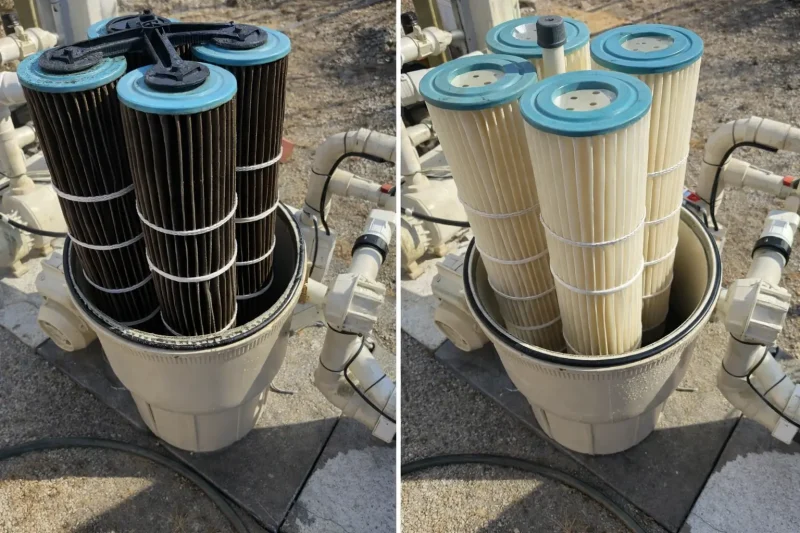
The trouble with cartridges is what sticks to the fabric. Dirt rinses off. Oils and calcium don’t. Water moving through a cartridge too fast drives dirt, minerals and oils deep into the media. After that, a normal cleaning won’t release them. A cartridge is due for cleaning once pressure sits about 10 psi above its clean starting pressure. If pressure jumps right back up after a good cleaning, or the pleats are matted together in clumps, the element is near the end of its life.
A second set of cartridges makes cleaning painless. You swap the clean set in, the pool keeps running, and the dirty set gets a proper soak and dries out before its next turn. Cartridges last longer that way too, because nobody is tempted to rush the cleaning.
DE Filters
DE filters catch the smallest particles of any pool filter, down to roughly 2 to 6 microns. Inside the tank, fabric-covered grids hold a coating of diatomaceous earth powder, and that powder does the actual filtering. You backwash a DE filter once pressure climbs 8 to 10 psi over its clean starting point. Then it needs a fresh charge of powder, a step called precoating.
Getting the powder amount right matters. Too little DE leaves bare spots on the grid fabric, so oils and debris clog the cloth directly. Flow drops, and over time the grids tear. Backwashing alone never gets everything off, either. DE grids need a full teardown and soak on a regular schedule, generally around every three months of operation. One safety note if you handle DE yourself: dry powder can contain crystalline silica. Breathing that dust is a real lung hazard (see OSHA’s crystalline silica guidance), so wear a proper mask.
Sand Filters
Sand filters trap particles in roughly the 25 to 100 micron range, so they filter coarser than cartridges or DE. They’re cleaned by backwashing, which reverses the flow and flushes trapped dirt out to waste. The trigger is the same 8 to 10 psi rise over clean pressure. A sand filter also needs freeboard, the empty space above the bed, so the sand can lift and expand during a backwash. Overfilled sand never cleans out fully.
Here’s the part most people get backwards: backwashing a sand filter on a fixed schedule makes it filter worse. A slightly dirty sand bed actually traps finer particles, because the gaps between grains narrow as dirt collects. Backwash too early and those gaps never tighten. Oils are the other enemy. They glue sand into clumps called mudballs, and water then channels around them without being filtered. Pool sand usually lasts somewhere between five and 15 years. When the grains feel smooth and rounded instead of sharp, it’s time for a sand change.
Run Time, Flow and Water Clarity
A clean filter only helps when water actually moves through it. One full turnover of your pool’s water filters about 63% of it, and it takes roughly four turnovers to filter all but 2%. That’s why pump run time matters as much as the filter itself, especially in summer.
Flow can be too high, too. A pump that’s oversized for its filter pushes water through the media faster than the media is rated for. On a cartridge, that drives oils and minerals deep into the fabric. On a sand filter, it forces dirt down into the bed, where backwashing can’t reach it. A simple clarity check works at home: stand on the deck and look at the main drain. If it looks fuzzy, the water is already cloudier than it should be.
Why North Texas Pool Filters Clog Faster
Local conditions decide how hard your filter works. A pool here deals with a heavier load than the pool-care guides written for milder climates assume.
Pollen, Dust and Leaves
Oak pollen arrives in spring as a yellow film on the water. Cottonwood fluff follows, and south winds carry dust and grass clippings in all year. Fall drops leaves from live oaks and cedar elms. The skimmer catches the big pieces, but the fine material goes straight to the filter. A pool with water that tests fine yet looks a little dull often has a filter that has stopped catching that fine dust. During heavy pollen weeks, check the gauge more often than usual, because pressure can climb much faster than it does in midsummer.
Hard Water and Calcium
Hard water is common across North Texas, and evaporation concentrates it through the summer. Calcium scale forms on cartridge pleats, DE grids and the inside of the tank. Scale shrinks the open area of the media, so pressure rises sooner after every cleaning. Our weekly pool service keeps water balanced with the Langelier Saturation Index, which slows scale from forming on the filter in the first place.
Sunscreen, Body Oils and a Long Swim Season
Swim season here runs from spring into fall, and every swimmer adds sunscreen, lotion and body oil. Oils coat filter media and trap dirt against it. They’re also why the cleaning order matters. Oils have to come off first with a degreaser. An acid wash before degreasing can set the oil right into the fabric, and then nothing gets it out.
What's Included in Our Pool Filter Cleaning
Every filter cleaning follows the same steps, adjusted for the type of filter you have.
Safe Shutdown and Full Disassembly
We shut off the pump and bleed the air pressure out through the air relief valve before anything opens. A pressurized filter tank is dangerous to open, and skipping this step is how people get hurt. Then we open the housing and pull the cartridges, grids or manifold so every part is reachable.
Cleaning the Media
Each cartridge or grid gets a thorough rinse to flush out loose dirt. Media with oil or calcium buildup then goes into professional cleaning solutions, a degreaser first and a descaler second when scale is present. That order keeps oils from locking into the fabric. On a sand filter, we backwash, check the bed for mudballs and channeling, and tell you if the sand has reached the point where cleaning won’t help.
Inspection While It's Apart
With the filter open, we check the parts that cause most filter problems:
- Grids and cartridges for tears or damage
- Manifolds for cracks
- Seals and O-rings
- The filter tank
- The backwash valve
- The pressure gauge
A bad gauge is more common than people think, and it can make a clean filter look dirty or a dirty one look fine. If anything is worn or failing, we tell you right away and recommend pool filter repair or replacement.
Reassembly, DE Recharge and Pressure Test
We reassemble the filter, recharge DE filters with the correct amount of powder, and restart the system. Then we check flow and note the new clean pressure. That number is your baseline. When the gauge reads about 8 to 10 psi above it, the filter is due again. You get a full report of what we found and what we did.
How Often Should You Clean Your Pool Filter in North Texas?
Most pool filters in North Texas need a professional cleaning every three to six months. The right interval for your pool depends on:
- Your filter type
- How much the pool gets used
- Trees and landscaping around the pool
- Recent storms
- If you use a pool cover
- Spring pollen and fall leaf season
Let the pressure gauge make the call instead of the calendar. One exception: after an algae bloom, clean the filter as soon as the water clears. Dead algae packed into the media still holds nutrients that can feed the next bloom. Cleaning too often isn’t a win either, because a filter with a little dirt in it traps fine particles better than a spotless one. Our Full Service weekly plan includes filter cleanings twice a year. Our techs also read the gauge at every visit in between.
Signs Your Pool Filter Needs Cleaning
Watch for these:
- Pressure 8 to 10 psi above the clean reading
- Cloudy or hazy water
- Weak flow from the return jets
- Debris blowing back into the pool
- Chlorine that’s hard to keep up
- Air bubbles or surging at the pump
These show up fastest in yards with heavy trees and during pollen season. Waiting until the water turns cloudy means the filter has been struggling for a while already.
Why Homeowners Choose Southern Pool + Outdoors for Filter Cleaning
We open the filter all the way and clean the media for what’s actually on it. We also inspect the parts most likely to fail, so small problems get caught before they turn into repair bills. You get honest recommendations, too. If cleaning won’t fix it, we’ll say so.
Your technician leaves detailed service notes. You’ll know what the filter looked like, what got cleaned and what pressure it’s running at now. If your gauge is climbing or the water looks dull, call (214) 922-1914 or schedule pool filter cleaning online.
Our Service Areas
- Allen
- Plano
- Dallas
- Mckinney
- Wylie
- Anna
- Fairview
- Prosper
- Lucas
- Celina
- Carlton
- Melissa
Pool Filter Cleaning Questions From North Texas Homeowners
Here are straight answers to the pool filter cleaning questions homeowners around North Texas ask most often.
Most North Texas pool filters need a professional cleaning every three to six months. The pressure gauge is the better guide. Clean a cartridge when it reads about 10 psi over its clean pressure, and backwash a sand or DE filter at 8 to 10 psi over. Heavy pollen, trees and swim traffic shorten the interval.
Yes. Cartridges and DE grids can be cleaned and reused many times, and pool sand usually lasts five to 15 years. Reuse stops making sense once a cartridge's pressure jumps right back up after cleaning or its pleats mat together. Torn grid cloth and sand worn smooth mean the same thing: replacement is the better fix.
A filter degreaser comes first, because oils from sunscreen and skin hold dirt in the pleats. If calcium scale remains after degreasing and rinsing, a descaling or acid-based filter cleaner removes it. Never acid-wash first. Acid on an oily cartridge can set the oil into the fabric permanently, and the cartridge never cleans up again.
Pool filter cleaning cost depends on the filter type and size, with DE grids taking the most work. Call (214) 922-1914 for a quote. Our Full Service weekly plan already includes filter cleanings twice a year. Your technician also reads the filter gauge at every weekly visit in between.
It depends on the type. You backwash a sand filter until the sight glass runs clear. A DE filter needs a backwash, then a fresh charge of DE powder, plus a full grid teardown and soak every few months. Cartridges come out for a hose rinse and a degreaser soak. Always shut off the pump and release air pressure before opening a filter.
Yes. A filter with a little dirt in it traps fine particles better than a spotless one, especially sand. Backwashing or cleaning on a fixed schedule wastes water and can leave the water less clear. Mark your clean pressure on the gauge and clean when it rises about 8 to 10 psi above that mark.
Only after degreasing, and only if calcium scale is still there. Acid removes minerals, but it does nothing for oil and can bake oil into the fabric if you skip the degreaser. North Texas hard water does leave scale on cartridges, so an occasional descaling soak after a degreaser helps. Rinse thoroughly afterward.
We don't recommend it. A high-pressure nozzle can push dirt deeper into the fabric and fray the pleats, which shortens the cartridge's life. A strong garden hose spray, worked pleat by pleat from top to bottom, does a better job. Follow it with a degreaser soak and the cartridge stays intact.
The usual causes are a cartridge at the end of its life, matted pleats, oil or scale left in the media, or a bad pressure gauge. Gauges fail more often than people expect. Swap the gauge first, since it's the cheapest fix. If pressure still climbs, the cartridge, grids or sand likely need replacement.
Plan on a full teardown and soak around every three months of operation, sooner in heavy pollen season. Backwashing removes most of the spent powder but leaves oils and fine debris on the grid cloth. A teardown is also the only time anyone can spot torn grid fabric before it lets DE powder blow back into the pool.
Still have questions?