Cloudy pool water almost always means one of three things: the filter isn’t catching fine particles, the chlorine is used up, or the water balance has drifted so far that calcium is falling out of solution. Hard fill water and triple-digit summers push on all of them here, so a North Texas pool can go from clear to hazy in a week.
You can usually fix the cause without buying a cart full of products. Here’s the order a route tech checks things, plus the numbers to aim for.
What Causes Cloudy Pool Water?
Cloudiness is millions of particles too small for your filter to catch and too tough for chlorine to burn off. Your eye can’t pick out a single particle under about 40 microns, which is a little over half the width of a human hair. Put enough of them in the water, though, and the whole pool turns milky.
The usual sources are a filter or pump that can’t keep up, used-up chlorine, drifting water balance, and outside debris like pollen, dust, leaves and early algae. Swimmers add their share, too, since sunscreen and sweat eat chlorine.
Try this test before you buy anything. Stand on the deck and look at the main drain in the deep end. If its edges look fuzzy, the water is cloudier than it should be. The CDC tells swimmers to make sure they can see the drain at the bottom of the deep end before getting in. Cloudy water can also hide a swimmer in trouble.
| What you see | Likely cause | First move |
|---|---|---|
| Dull haze, water tests fine | Dirty filter or short run time | Check filter pressure |
| Haze plus chlorine smell or red eyes | Combined chlorine | Shock to 10 times the combined reading |
| Milky white, crust at the tile line | High pH, alkalinity or calcium | Lower pH with acid |
| Hazy with chlorine “in range” | Stabilizer (CYA) too high | Test CYA |
| Cloudy after a storm or pollen week | Debris, diluted chlorine | Skim, run the pump, test |
| Dull, green tint, slick walls | Early algae | Brush, raise chlorine |
Cause 1: The Filter or Pump Can't Keep Up
Poor filtration and weak circulation are the most common reasons a pool goes cloudy, so check the equipment first. No product works if water isn’t moving through clean filter media.
Start with the pressure gauge on top of the filter. Once it reads 8 to 10 psi above its clean starting pressure, the media is loaded and it’s time to clean it or backwash. A filter system in good shape should bring the water back to clear within about 8 hours after a heavy swim day. If yours takes days, something is off.
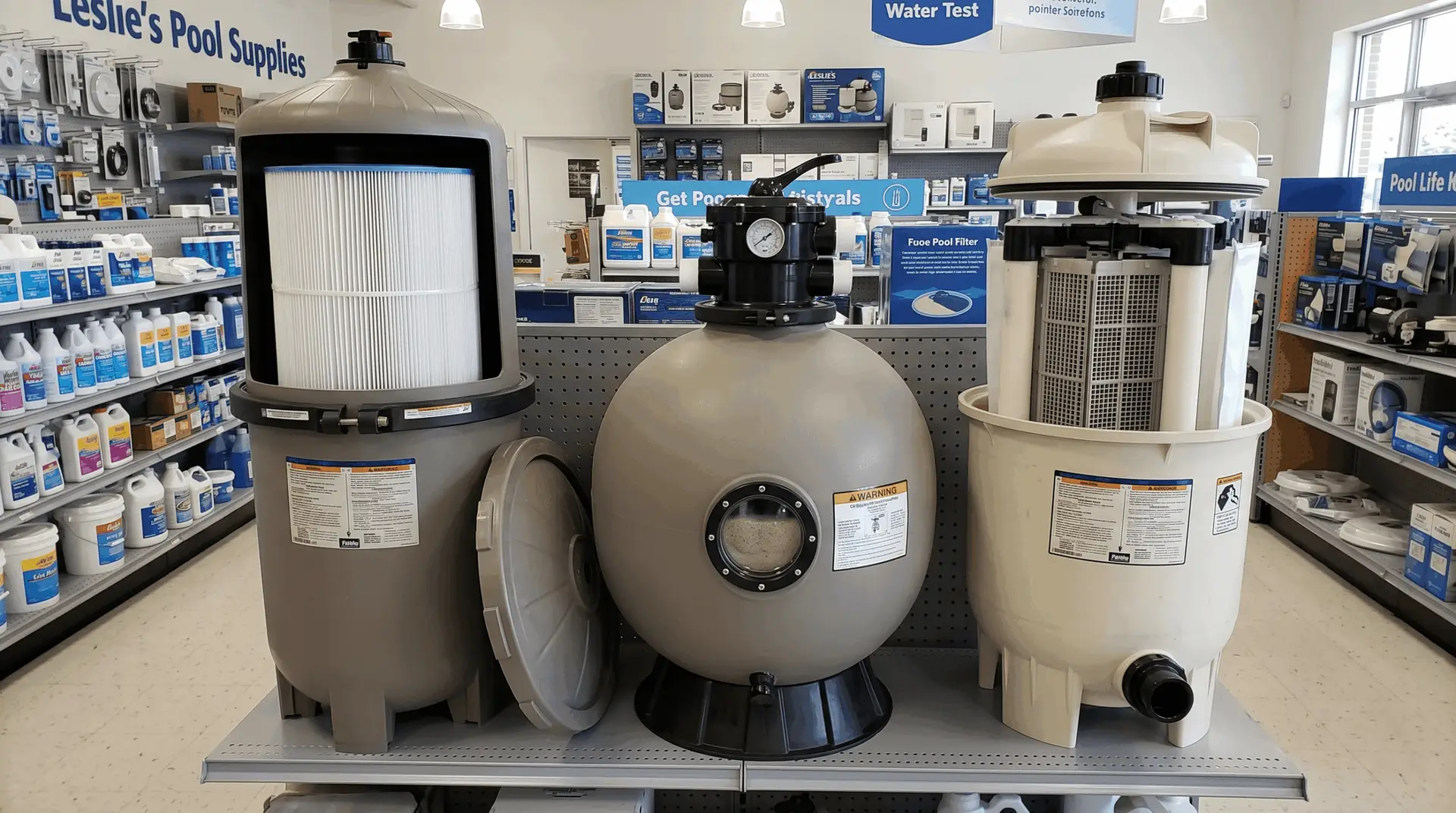
Filter type matters too. Sand traps particles down to roughly 25 microns, and a cartridge catches them down to about 15, so fine haze slips through sand more easily. If you’re weighing a switch, read our breakdown of sand vs cartridge vs DE pool filters.
Why Pump Run Time Matters
One full turnover means the pump has moved a pool’s worth of water through the filter. That first turnover still leaves about 37% of the water unfiltered. A second gets it down to 14%, a third to 5%, and it takes four turnovers to reach 2%. That’s why a pool on a short timer can stay hazy for days even with good chemistry.
One turnover moves a pool's worth of water through the filter, but it takes about four to filter all but 2% of it.
Source: industry operating guidelines
| Turnovers completed | Water not yet filtered |
|---|---|
| 1 | 37% |
| 2 | 14% |
| 3 | 5% |
| 4 | 2% |
Our guide on how long to run your pool pump covers summer and winter schedules.
Cause 2: Chlorine That's Low or Used Up
Free chlorine is the part of your chlorine that’s still working. Keep it at 2 to 4 ppm, and never let it fall below 1 ppm. When it drops, bacteria and fine organic debris build up faster than the filter can pull them out, and the water goes dull.
North Texas sun is hard on chlorine. In an outdoor pool with no stabilizer, sunlight can destroy half the chlorine in less than an hour. Add a full Saturday of swimmers during a 100-degree stretch, and the chlorine can be gone by Sunday morning.
Combined Chlorine and North Texas Tap Water
Then there’s combined chlorine. When chlorine reacts with sweat and urine, it forms chloramines. Your test kit reads them as combined chlorine, which equals total chlorine minus free chlorine. They cause the “chlorine smell” and red eyes, and they do very little sanitizing. Many health codes cap combined chlorine at 0.2 ppm in pools.
North Texas tap water adds a twist. If your city buys water from the North Texas Municipal Water District, your tap water carries chloramine, a mix of chlorine and ammonia, except during a month of chlorine-only maintenance each spring. That works fine in a drinking glass. In a pool, though, that fill water shows up as combined chlorine on your test. So a big top-off after a week of evaporation can raise the reading before anyone swims.
The fix is breakpoint chlorination: raise free chlorine to about 10 times the combined reading. So 0.5 ppm of combined chlorine calls for about 5 ppm of free chlorine. A half dose won’t reach breakpoint and mostly wastes chlorine. Done right, a shock like this often clears a dull, hazy pool, because it breaks down organic gunk so the filter can catch it.
Cause 3: High pH and Hard North Texas Water
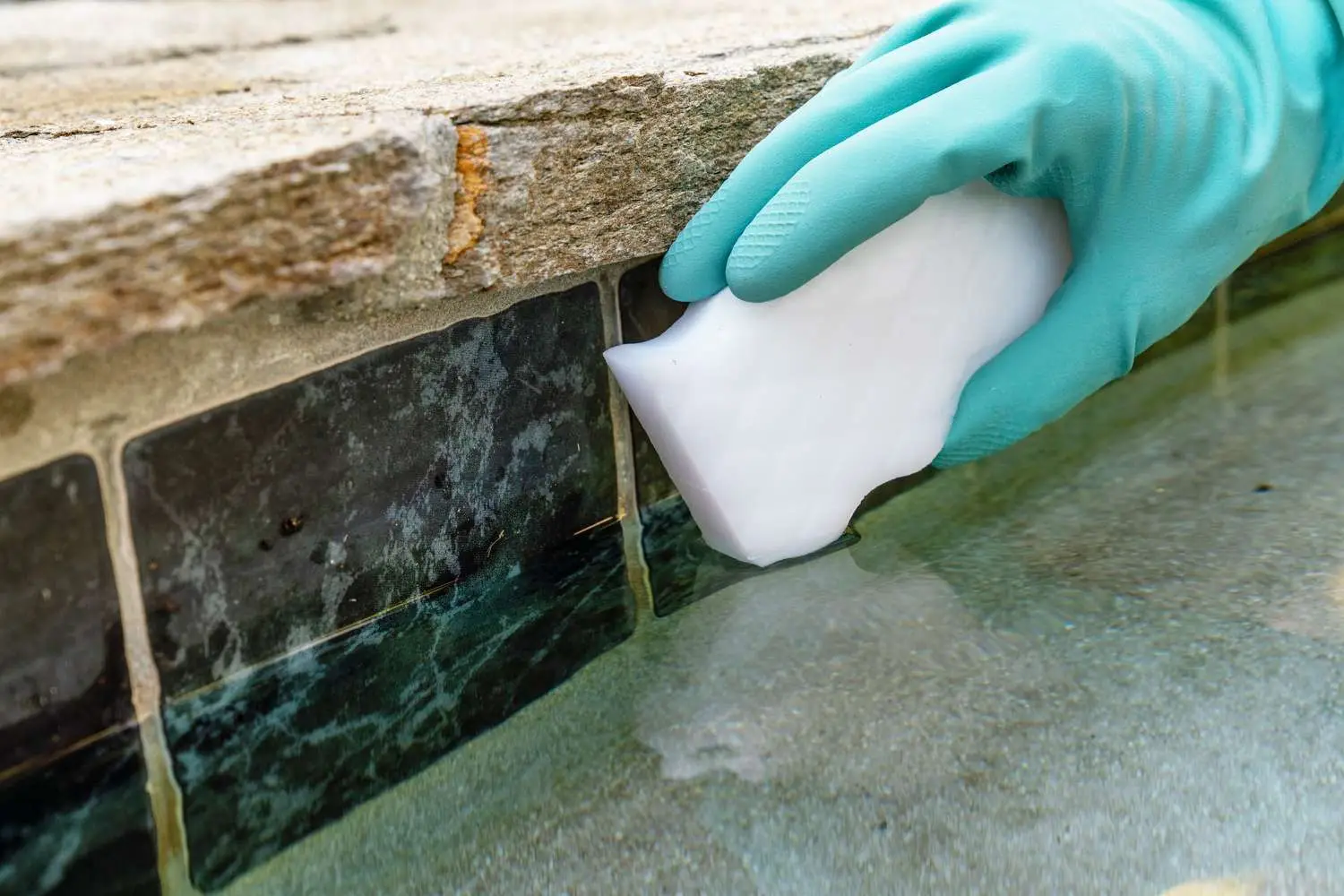
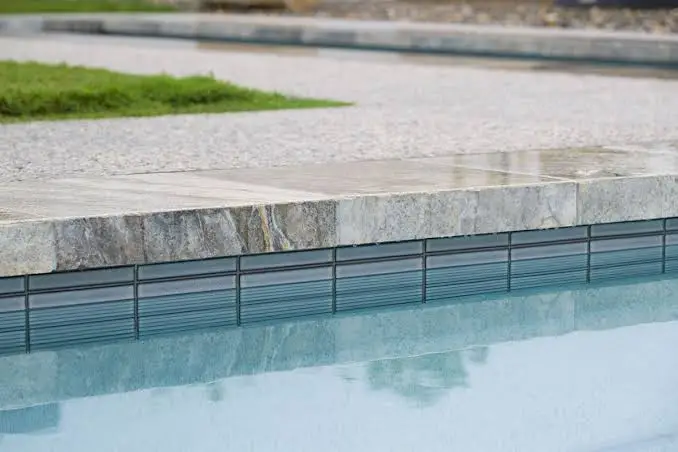
This is the milky white kind of cloudy, and pools across the Metroplex fight it hardest in summer. When pH, alkalinity or calcium run high, calcium carbonate drops out of the water as a fine white haze. It’s the same mineral that builds the gray crust at your tile line.
Aim for a pH of 7.4 to 7.6, close to the 7.5 pH of your eyes. Anything from 7.2 to 7.8 is acceptable. Above that, scale and cloudy water get likely, and chlorine gets weaker. At a pH of 7.5, about half of your free chlorine is in its strong form. At 7.8, only about a third is.
Total alkalinity should sit at 80 to 120 ppm, because it anchors pH. As it climbs toward 180 ppm, pH creeps up and won’t come down, which sets up cloudy water. That’s also why baking soda won’t clear a cloudy pool. It raises alkalinity, so it makes a high-pH haze worse.
Calcium hardness should stay at 200 to 400 ppm for plaster. Our fill water already carries plenty of calcium, and every inch of evaporation leaves minerals behind while the top-off brings in more. Calcium also gets less soluble as water warms, so water that looked fine in April can cloud and scale by August. Past 500 ppm, you have to hold pH and alkalinity low to keep calcium in solution. Near 1,000 ppm, the real fix is draining some water and refilling.
Why a Pool Turns Cloudy After Shock
Calcium hypochlorite shock, sold as cal-hypo, adds calcium and pushes pH up. In hard, high-pH water, that can throw calcium out of solution, so the pool looks worse right after a bag of shock. Lower the pH first. In pools that already run high on calcium, liquid chlorine is the better choice, since it adds no calcium.
A short haze after shocking can also be a good sign. It’s dead algae and broken-down organics waiting for the filter, and it fades as the filter catches up.
Cause 4: Stabilizer (CYA) That Crept Too High
Cyanuric acid, sold as stabilizer or conditioner, shields chlorine from the sun so it lasts three to ten times longer. The target is 30 to 50 ppm. The catch is that CYA doesn’t leave the water. Every trichlor puck in your floater adds more, and the level keeps climbing as long as you use pucks.
When stabilizer runs too high, chlorine still reads “in range” but works more slowly. Algae and organics get a head start, and the water turns hazy while the numbers look normal. You can’t filter CYA out or burn it off with shock. The only fix is replacing part of the water.
Plenty of pools in Plano and McKinney run on pucks all summer. That works for a season or two, but after that, test stabilizer every month instead of guessing.
Cause 5: Pool Cloudy After Rain or Pollen Season
North Texas springs are rough on pool water. Oak pollen lays a yellow film on the surface, and cottonwood fluff follows. South winds blow in dust, then a spring storm, sometimes with hail, dumps an inch of rain in an afternoon.
Rain dilutes chlorine, and heavy rain can drop alkalinity fast. It also washes in dirt and lawn fertilizer, and fertilizer and rotting leaves carry phosphates that feed algae. So after a big storm, the pool has more to filter and less chlorine to work with.
After a storm, run the pump through the weather, then skim and empty the baskets. Test chlorine and pH the same day, and brush so settled debris reaches the filter. Check the filter pressure, too, since storm debris loads it quickly.
Fall brings its own mess. When a norther blows through, live oak and cedar elm leaves land in the pool and sink to the corners, where they feed algae and use up chlorine.
Cause 6: Early Algae Before It Turns Green
Algae spores blow into every outdoor pool, every day. Before a bloom turns the water green, it usually shows up as a dull, slightly cloudy look and walls that feel slick. In warm water, some algae can turn a clear pool green in less than a day. So a cloudy pool in July deserves attention the same afternoon.
Brush the walls and steps, especially behind the ladder, where water barely moves and algae starts first. Then raise the chlorine and keep the pump running. Algae needs more chlorine to kill when stabilizer is high, which is one more reason to test CYA. If the water has already turned green, that’s a recovery job, and our green to clean page explains how we clear it.
How to Clear Cloudy Pool Water, Step by Step
Order matters. Start with the equipment and fix the chemistry before you open a bottle of anything.
- Check the pump and filter. Clean or backwash if pressure is 8 to 10 psi above clean, and make sure the pump runs long enough each day.
- Test the whole panel: free and total chlorine, pH, alkalinity, calcium and stabilizer.
- Fix alkalinity and pH first. Bring pH down to 7.4 to 7.6 with muriatic acid if it’s high.
- Raise free chlorine. If combined chlorine shows up, take free chlorine to about 10 times that reading.
- Brush the whole pool and run the pump around the clock until the water clears.
- If a haze still hangs on after all that, try a clarifier.
| Test | Target | Cloudy-water warning sign |
|---|---|---|
| Free chlorine | 2 to 4 ppm | Below 1 ppm |
| Combined chlorine | 0.2 ppm or less | Higher, with a chlorine smell |
| pH | 7.4 to 7.6 | Above 7.8 |
| Total alkalinity | 80 to 120 ppm | Climbing toward 180 ppm |
| Calcium hardness | 200 to 400 ppm | Over 500 ppm |
| Stabilizer (CYA) | 30 to 50 ppm | Above 50 ppm and climbing |
For a weekly, monthly and seasonal routine that keeps cloudiness from starting, use our pool maintenance checklist.
Clarifier or Flocculant?
Most clarifiers carry a positive charge, and the particles that cloud water carry a negative one. So clarifier clumps them into pieces big enough for the filter to trap. It works when the filter is clean and the water is balanced. If you’re on your third bottle, though, the problem is upstream of the clarifier.
Flocculant is the heavy hammer. You circulate it for about four hours, then shut the pump off for 12 to 24 hours while the clumps settle to the floor. After that, you vacuum the floor to waste. If your filter has no waste setting, which is common with cartridge filters, floc is a poor fit.
When to Call a Pro About a Cloudy Pool
Still hazy after a few days of clean filters and balanced water? Our weekly pool service puts a dedicated route technician on your pool every week to test and balance the water. You get a digital service report with the chemical readings after each visit. Plans start at $179 a month with no long-term contracts, and you don’t need to be home.
The Full Service plan includes filter cleaning twice a year. If the filter is cracked or won’t hold a clean pressure, that’s a job for pool filter repair. When calcium or stabilizer climbs too high to treat, our Drain & Clean service drains and chlorine washes the pool, cleans the equipment and filter, then refills and rebalances.
We work on pools in Allen, Plano, Frisco and Prosper every week. Call (214) 922-1914, Monday through Friday from 8 to 5, or schedule service online.
Cloudy Pool Water Questions From North Texas Pool Owners
These are the questions we hear most, from Google searches and from pool owners on local forums.
What is the most common cause of cloudy pool water?
Poor filtration or circulation is the most common cause, with water chemistry right behind it. Check the filter pressure first, and clean or backwash if it reads 8 to 10 psi above clean. In North Texas summers, high pH and calcium from hard fill water are the next things to test.
How long does it take for a cloudy pool to clear up?
A mild haze from a heavy swim day should clear within about 8 hours once the filter is clean and the pump is running. Cloudiness caused by chemistry clears only after you fix the cause, and then it takes about four turnovers to filter all but 2% of the water. Flocculant takes the longest to set up: about four hours of mixing, 12 to 24 hours of settling, then vacuuming.
Why does shocking my pool make it cloudy?
Cal-hypo shock adds calcium and raises pH, and in hard, high-pH water that can push calcium out as a white haze. A short haze can also be dead algae and organics the chlorine just broke down, and it fades as the filter catches up. Lower the pH before you shock, and use liquid chlorine if your calcium already runs high.
Will baking soda clear up a cloudy pool?
No. Baking soda raises total alkalinity, and high alkalinity pushes pH up, which is one of the things that clouds water. Use it only when alkalinity tests below 80 ppm.
Is it safe to swim in cloudy pool water?
Not if you can't see the main drain clearly from the deck. The CDC tells swimmers to check that they can see the drain at the bottom of the deep end, and cloudy water can hide someone in trouble. Clear the water and get free chlorine back to 2 to 4 ppm before anyone swims.
Is a cloudy pool as simple as superchlorinating, or is something else going on?
Sometimes shock is enough, but check pH and the filter first. Shock clears cloudiness from combined chlorine and organics, yet it won't fix a dirty filter, and cal-hypo in high-pH water can make the haze worse. Get pH to 7.4 to 7.6, then raise free chlorine to about 10 times the combined reading.
Can high chlorine on its own make the water cloudy?
Usually the product is the problem, not the chlorine level. Cal-hypo adds calcium and pushes pH up, and in hard North Texas water that can turn a pool milky. Test pH and calcium before you add more shock, and switch to liquid chlorine if calcium runs high.
Shouldn't the clarifier have cleared it up a bit by now?
Clarifier only works once the filter is clean and the water is balanced. It clumps fine particles so the filter can trap them, so a dirty filter, high pH, high calcium or high stabilizer will keep the pool cloudy no matter how much you add. Fix those first, then run the pump around the clock.
My chlorine and pH look fine, so why is my pool still cloudy?
Test stabilizer and combined chlorine next. High CYA from years of trichlor pucks slows chlorine down, so the water can haze up while the test looks normal. Combined chlorine from heavy swimming or chloraminated NTMWD fill water can also hide inside a total chlorine reading that looks fine.
My pool turned murky after heavy rain. What should I do?
Run the pump through the storm, then skim and brush, and test chlorine and pH the same day. Rain dilutes chlorine and can drop alkalinity fast, and it washes in dirt and fertilizer. After a spring storm in Allen or Frisco, raise free chlorine back to 2 to 4 ppm and check the filter pressure, since storm debris loads it quickly.