Good pool tile ideas for North Texas start with a question most photo galleries skip. How will this tile look with a white line of calcium across it in August? Our fill water is hard, and triple-digit summers pull water off the surface every day. The minerals stay behind, right on the tile.
This guide starts with the looks. Then it covers what decides if you’ll still like that tile in five years: pairings with coping and plaster, scale, freeze and shifting clay, plus safety tile on the steps.
Pool Tile Ideas Start at the Waterline
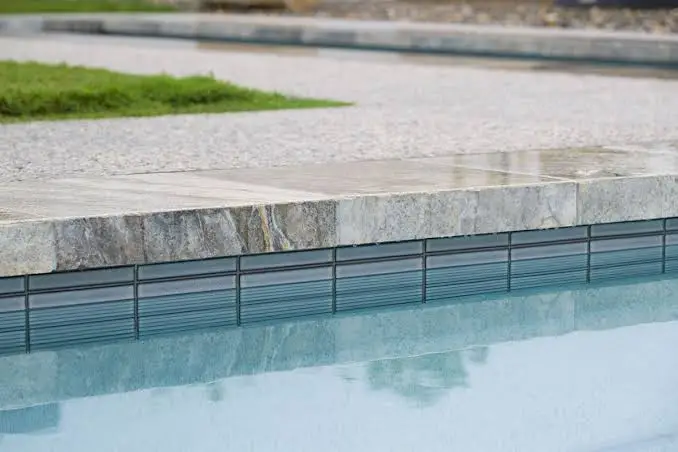
On most plaster pools, tile covers a band where the water meets the wall. That band takes the worst of it. Oils, dirt and spring oak pollen collect there as a scum line, and every bit of evaporation leaves calcium on the same strip.
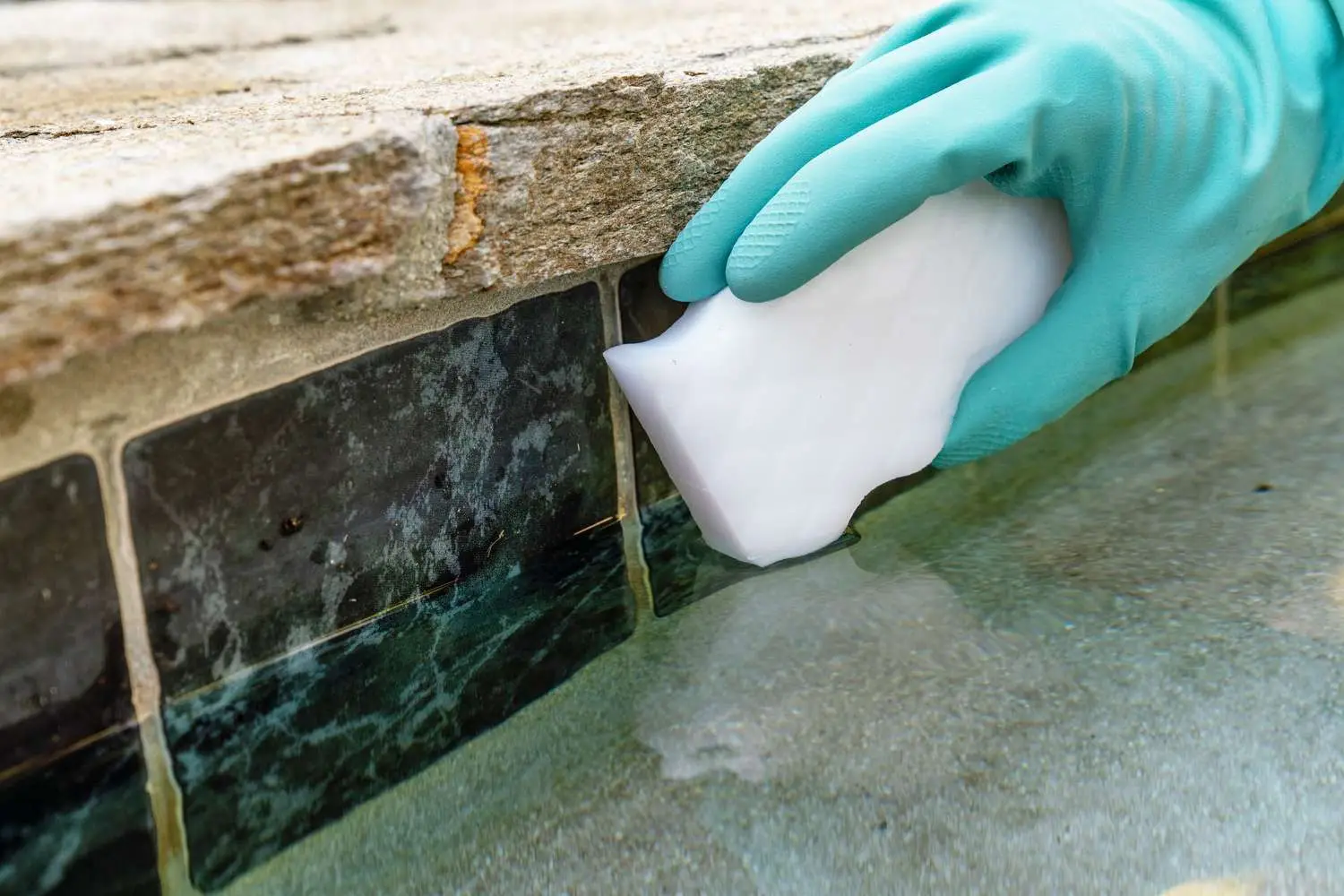
Pool tile has a glazed, non-porous finish. That’s why a brush and a nonabrasive cleaner can bring it back. Plaster has no glaze, so scale and grime grab onto it, which is the whole reason the tile band exists.
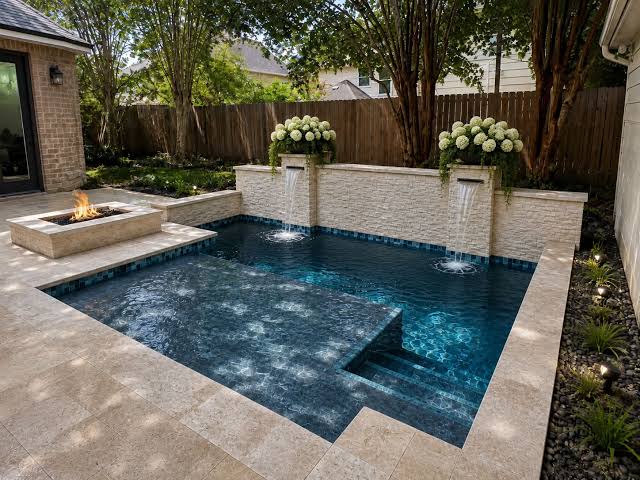
Some pools carry tile further, onto a spa wall, spillway faces, step edges or a raised wall behind the pool. Each of those spots gets wet and dries over and over, so each one scales faster than the floor. Plan the design around that and the tile stays good-looking with normal care.
Pool Waterline Tile Ideas by Material
Four materials cover most residential waterlines in the Metroplex. Most pool tile ideas you’ll find online use one of them, and each one behaves a little differently with our water.
Porcelain Pool Tile
Porcelain is the workhorse. The Tile Council of North America defines porcelain as tile that absorbs 0.5% water or less. Non-porcelain tile absorbs more. That low absorption is what you want in a tile that sits half underwater for decades.
Porcelain pool tile comes in solid blues, grays and greens, plus stone and wood looks. You can get it in 6×6 squares or small mosaics. Matte and textured faces hide a light scale film better than high gloss. For most Allen, Plano and McKinney pools, it’s where we’d start.
Glass Pool Tile
Glass brings the sparkle, especially iridescent blends that shift color in the afternoon sun. It’s non-porous too, so scale sits on the surface instead of soaking in. The catch is that glass is usually darker and shinier than porcelain. A white calcium line shows up on it like chalk on a blackboard.
Glass mosaics also need careful setting. Every small piece needs a full bed of thinset, because a hollow spot behind it holds water. If you love glass, use it as an accent row or on a spa spillway. Run porcelain on the long walls.
Natural Stone vs. Stone-Look Porcelain
Ledgerstone and split-face stone look right at home under Texas limestone coping. Real stone is a different animal, though. Limestone and travertine are made of calcium carbonate, the same mineral as the scale on your tile. That means the acid cleaners that take scale off can also eat into the stone.
Stone-look porcelain gets you the texture without that weakness. We’d put stone-look porcelain at the waterline and save real stone for the coping, up above the water.
Where Mosaics Fit
Mosaics work best in small doses: a border under the main band, a spa wall, a sun shelf accent. A 1×1 mosaic has far more grout lines than a 6×6 tile, and grout is the soft spot. Water that runs low on pH or calcium attacks tile-line grout more than almost anything else. Algae also likes to start in those joints, so more grout means more brushing.
| Tile type | The look | How calcium shows | Watch for |
|---|---|---|---|
| Porcelain | Solid colors, stone and wood looks | Matte and mid-tones hide a light film | Dark high-gloss styles show the line |
| Glass | Sparkle, iridescent blends | A white line stands out | Needs a full thinset bed behind each piece |
| Natural stone | Real texture | Blends in at first | Acid that removes scale etches the stone |
| Mosaic | Borders, patterns, spa walls | Depends on the color | Lots of grout to keep up |
Pool Tile Colors That Work With Your Coping and Plaster
Tile never shows up alone. It sits between the coping above and the interior finish below. The finish color sets the water color, and our guide to pool plaster colors covers that side of it. The best pool tile and coping ideas come from choosing all three together.
Here are a few pairings that hold up well.
- Gray or silver porcelain with Platinum Ice or Ivory Travertine coping and a gray finish. It looks clean and forgives a little scale.
- Warm stone-look or ledgerstone tile with Lueders Texas Limestone coping, which suits a lot of the ranch-style homes out in Lucas and Fairview.
- A deep blue tile over a light finish for bright, classic blue water.
- Emerald or green accents with a darker finish if you want a lake look.
If you go blue, pick a tile a step darker or lighter than the water. Otherwise the band disappears into the pool and you lose the line you paid for.
How to Judge Pool Tile Samples
Our remodel list includes Quartzite Classic Ledgerstone, Coral Rustic with Lightwaves Blue, Gemstone Emerald and Starburst Smoke Gray. The names point the way: ledgerstone texture, a rustic tile with a blue, an emerald and a smoke gray.
Whatever y’all lean toward, judge samples wet, outside and in full sun. Hold each one against your coping and a chip of your finish. A tile that looks great on a showroom table can clash once the pool is full. Also think about the view from the house, since you’ll see that band from the kitchen window in January too.
Why North Texas Water Leaves a White Line on Pool Tile
Most North Texas tap water is hard before it ever reaches your pool. Evaporation takes pure water off the surface and leaves the dissolved minerals behind, so every top-off adds more calcium. Calcium is also odd. It gets less soluble as water warms up, which is the opposite of most chemicals.
Put those together in July and the tile line is warm, drying out and loaded with calcium. That’s when calcium carbonate drops out of the water as scale. It starts as a thin white film. Left alone, it hardens into a rough gray crust that collects dirt and won’t brush off.
What the Saturation Index Measures
Pool pros use the saturation index, the pool version of the Langelier index, to tell if water will dissolve calcium or deposit it. The math adds factors for pH, temperature, calcium hardness and alkalinity, then subtracts one for total dissolved solids (TDS). Zero is ideal. Anything between -0.3 and +0.3 counts as balanced, and above +0.3 the water starts laying down scale.
Why the Same Water Scales in August
Take water at pH 7.6, calcium hardness 400 ppm, alkalinity 100 ppm and TDS over 1,000 ppm. At 60°F the index is 0.0, dead balanced. Warm it to 84°F and it’s +0.3, right on the edge. At 94°F it’s +0.4 and scale forming. A 104°F spa reads +0.5. Nothing changed but the temperature, so the spa spillway and tile line scale first, and summer water needs a bit less pH and alkalinity than spring water.
Water that tests balanced at 60°F is scale forming by 94°F.
Source: industry operating guidelines (saturation index factors).
| Water temperature | Saturation index | Reading |
|---|---|---|
| 46°F | -0.2 | Balanced |
| 60°F | 0.0 | Balanced |
| 76°F | +0.2 | Balanced |
| 84°F | +0.3 | Balanced, at the edge |
| 94°F | +0.4 | Scale forming |
| 104°F spa | +0.5 | Scale forming |
Which Tiles Hide Scale Best
No tile stops scale. Water balance and evaporation make it, and it bonds to glass and porcelain alike. What the tile changes is how much you notice it.
- Mid-tone gray, silver and blue-gray porcelain hide a light film best.
- Matte and textured faces hide it better than high gloss.
- White or very light tile hides white scale, though dark grout between the tiles can still show it.
- Dark glossy glass and deep cobalt show every bit of it.
Water Balance Keeps Tile Looking New
Good tile care is mostly water care. Keep these three numbers in range:
- pH: 7.4 to 7.6
- Alkalinity: 80 to 120 ppm
- Calcium hardness: 200 to 400 ppm
With hard fill water you can’t easily bring calcium down, so you hold the balance with pH and alkalinity. Lowering calcium takes a partial drain and refill, or a water softener on the fill line.
Then brush the tile line every week with a nonabrasive tile cleaner that won’t foam or add phosphates. A scale inhibitor or sequestering product helps through the hot months. Skip scouring pads and pumice, because they scratch the glaze that keeps tile easy to clean. On our weekly pool service routes we keep pH between 7.4 and 7.6. Every visit ends with a digital report of the chemical readings.
Once scale hardens, brushing won’t touch it. If it has spread onto the plaster, that’s a bigger job for an acid wash on a drained pool.
How Freezes and Shifting Clay Pop Pool Tile Loose
North Texas doesn’t freeze often, but the February 2021 freeze showed what a long, hard one can do. The Tile Council of North America says water in grout joints that freezes can damage even frost-resistant tile. Hollow spots in the setting bed behind a tile cause the same trouble. So the grout and the bond behind the tile matter as much as the tile itself.
Then there’s the ground. Blackland Prairie clay swells in a wet spring and shrinks in an August drought, and the deck rides along. A flexible expansion joint should separate the deck from the pool. If that joint is missing or packed solid, the moving deck pushes on the tile line and coping until tiles start letting go.
Loose or popping tiles can also be a sign of a leak. Before you reset anything, run a bucket test. Set a bucket on the second step, fill it to the pool’s water level and mark both lines. After 24 hours with the pump running, a pool that dropped more than the bucket points to a leak. If so, have our pool repairs team take a look before anyone retiles. New tile over a leak or a moving deck just means doing it twice.
Pool Tile Ideas for Steps and Depth Markers
On steps, tile does more than look good. Steps and benches need to stand out to anyone walking in or looking down from the deck. A continuous dark band in a contrasting color does that job. Public pool inspection standards call for contrasting tile on both the top edge and the riser of each step. The underwater markings should be permanent, so feet, sun and chlorine don’t wear them away.
Slip resistance matters too. Glazed tile usually stays off the flat part of a step, where people put their weight. Ask for a trim with a textured or slip-resistant face on the tread.
Depth markers are the other safety tile worth adding. Codes for public pools usually call for them on the wall at or above the water line. They also go on the edge of the deck, in slip-resistant tile. A backyard pool isn’t held to the same rules. Still, with a deep end and grandkids visiting from Frisco, a few depth markers in contrasting tile are worth it.
When It's Time for New Tile
Plenty of tile only needs cleaning. If the tile is sound and just scaled, start with tile cleaning. Professional blasting matches the media and pressure to your tile type. New tile makes sense for cracked, loose or etched tile, or scale that won’t come off anymore. It also makes sense when you’re simply done with that blue band.
Tile and coping usually go together. They sit on the same edge, and the same clay moves them both. On a remodel the tile, coping and decking go in first, and the new interior finish goes on last. Most pools need a new interior finish every five to eight years anyway. Lining the new tile up with that resurfacing means opening the waterline once.
A remodel is also the easy time to put these pool tile ideas to work, from step trim to depth markers, while the pool is empty. With our pool remodeling work, you see finish, tile and stone samples before construction starts. That way you pick the band, the coping and the water color together.
Ready to plan new tile? Call (214) 922-1914, Monday through Friday from 8 AM to 5 PM, or get an instant pool quote online.
Pool Tile Questions From North Texas Pool Owners
Short answers to common questions about pool tile ideas, scale and loose tile around the Metroplex.
What type of tile is best for a pool?
For most North Texas waterlines, porcelain pool tile is the best all-around pick. It absorbs 0.5% water or less and comes in nearly every color. Matte or mid-tone styles also hide light calcium scale. Glass works best as an accent or on a spa spillway, and real stone belongs on the coping above the water.
Do you need waterline tile in a pool?
On a plaster pool, yes. The waterline collects the scum line and most of the calcium scale. Glazed tile gives that strip a non-porous surface you can brush clean. Without it, the scale and oils land right on the plaster.
Is porcelain or ceramic tile better for a pool?
Porcelain is the better choice. Under the Tile Council of North America's definition, porcelain absorbs 0.5% water or less. Non-porcelain ceramic absorbs more. You want less water in the tile body when the band stays half submerged and sees the odd hard freeze.
What are the disadvantages of glass pool tile?
Glass shows calcium more than most tile. It's usually darker and shinier, so a white line stands out. Glass mosaics also need a full bed of thinset behind every piece, since hollow spots hold water. A good middle ground is glass on an accent row or spa spillway, with porcelain on the main walls.
What is the best color tile for a pool?
The best color is the one that works with your plaster and coping. With North Texas water, mid-tone gray, silver or blue-gray porcelain is the most forgiving. It hides the light calcium film. Dark glossy glass and deep cobalt look great on day one but show every bit of scale.
Why do my pool tiles keep popping off?
Popping tile usually means water got behind it or something is pushing on it. Cracked grout lets water in, and a hard freeze can break the bond. A deck on Blackland Prairie clay can also push on the tile line without a flexible expansion joint. Loose tile can be a leak sign too, so run a bucket test before you reset anything.
Should I replace my tile when I resurface my pool?
Yes, if the tile has cracks, loose pieces or etching, or it's a color you're done with. On a remodel the tile goes in first and the new finish goes on last. Doing both together means opening the waterline once. Sound tile with only a scale line can usually come clean and stay.
What tile color goes with my coping?
Pick your tile against a real piece of your coping, wet and in full sun. Gray and silver porcelain pair well with Platinum Ice or Ivory Travertine. Warm stone-look tile suits Lueders Texas Limestone. If you go blue, choose a shade a step darker or lighter than the water so the band doesn't disappear.
Will a different tile stop the calcium line on my pool?
No. Calcium scale comes from hard fill water, evaporation and warm water, and it bonds to glass and porcelain alike. A matte or mid-tone tile hides it better. The real fix is steady water balance and a weekly brushing of the tile line, plus a professional cleaning once scale hardens.
Is glass waterline tile a good idea in Dallas?
It can be, as long as you accept that glass shows calcium more than porcelain. Dallas-area water is hard and summer evaporation is high. A glass band needs weekly brushing and steady water balance to stay sharp. Glass on an accent row or the spa wall gets you the sparkle with less upkeep.