
Pool repair in North Texas. Pumps, filters and heaters, diagnosed and fixed. Call (214) 922-1914.

Southern Pool + Outdoors handles pool repair in North Texas. We find what failed, tell you what it costs, and say plainly whether the part is worth fixing or worth replacing.
Most repair calls out here come down to four things:
Timing matters here more than it does in milder places. A pool that is not circulating can go green within days in July, so a dead pump in summer is an urgent problem and the same pump in January is only an annoying one.
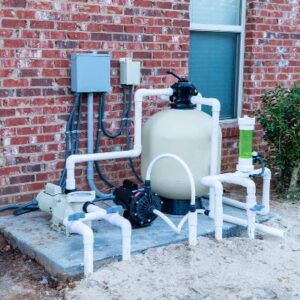
A filter that leaks or bypasses sends dirt straight back into the pool. No amount of chlorine fixes that.
We repair cracked tanks and clamp bands, replace split laterals and blown DE grids, rebuild multiport valves, and swap internals while the housing is still good. Worn sand is a sand change rather than a repair, and a filter that has simply packed full needs filter cleaning instead.
When the tank itself is finished, a new filter installation costs less than chasing the leak.
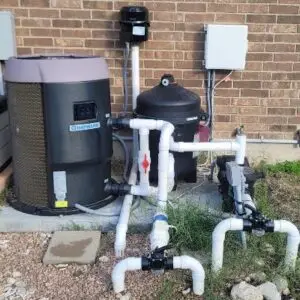
Heaters take the worst of our water. Hard fill water scales the heat exchanger, and scale kills more heaters around here than burners ever do.
We work through ignition faults, pressure switch trouble, error codes, flow problems and scaled exchangers. Half the heater calls we get turn out to be a flow problem rather than a heater problem, which makes for a cheaper day. A salt system that has scaled up usually points at the same water.
If the exchanger is gone, we quote a heater installation instead of a repair, and tell you why.
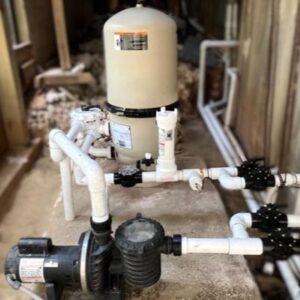
The pump moves every gallon in your pool. When it stops, filtration stops, and the chemistry goes with it.
Usual failures: worn bearings, a burned out motor, a leaking shaft seal, a cracked lid or basket, or a pump losing prime through an air leak on the suction side. Variable speed drives fail their own way, normally with an error code and no flow.
Sometimes the honest answer is a new pump. The U.S. Department of Energy covers the case for variable speed in its guide to choosing an efficient pool pump, and on an old single speed the power savings often cover much of the difference. That work goes through pool pump installation.
Equipment rarely quits without warning. Catch it at this stage and you get a repair instead of a replacement:
Call while it is still one of those. A bearing left alone takes the motor with it, and then a $200 repair becomes a new pump.
If the pool went green while the equipment was down, green to clean picks it up from there, and regular pool cleaning services keep it from happening twice.
Repairs are one piece of it. Here is the rest of what we handle for pools around North Texas.

Weekly visits, filter cleaning, tile cleaning and pool inspections, so the water stays clear and the equipment gets watched every week.
New pumps, filters, heaters and lights, sized for your pool and installed so circulation stays strong and the power bill stays sane.

Ignition faults, error codes, short cycling and scaled heat exchangers on gas heaters and heat pumps. Often it turns out to be flow, not the heater.

Acid wash, green to clean, automation, sand changes and salt systems, for the jobs that fall outside a repair call.
The questions we get asked most, answered straight. If yours is not here, call (214) 922-1914 and ask.
Pool repair cost depends on the part that failed. A seal or a pump lid is a small job. A burned out motor or a scaled heat exchanger is not. Call Southern Pool + Outdoors at (214) 922-1914 and we will quote the actual fault.
Call (214) 922-1914 and we will tell you the soonest we can be there. In summer a dead pump moves up the list, because a North Texas pool with no circulation can turn green within a couple of days.
Repair the pump when the motor is sound and the failure is a seal, a lid or a basket. Replace it when the motor has burned out on a unit eight or ten years old, since a new variable speed pump usually pays back much of the difference in power.
A failing pool pump gets louder, leaks at the shaft seal, loses prime, trips the breaker, or pushes weak flow from the return jets. Bearings give the clearest warning: the noise builds over weeks before the motor quits.
A pool pump loses prime when air gets into the suction side. The usual causes are a low water level, a cracked pump lid or lid O ring, a loose drain plug, or a leaking valve. Air spinning in the basket is the giveaway.
A pool heater that will not heat usually has a flow problem rather than a heater problem. Dirty filters, closed valves and a weak pump all cut flow, so the heater shuts down to protect itself. Scale from our hard water is the other common cause.
Yes. Fill water here carries a lot of calcium, and it leaves scale behind as water evaporates. Scale coats heat exchangers and salt cells, chokes flow and shortens the life of the whole equipment pad. Balanced water slows it down.
Pool equipment in Texas works harder than it does almost anywhere. Pumps commonly run eight to twelve years, heaters around ten, and filters longer when the tank is shaded. Heat, dust and hard water all shorten those numbers.
Fix the circulation first. Once water is moving again, the pool can be recovered with shock, filtering and repeated brushing, which is the green to clean job. Cleaning a pool whose pump is still down never holds.
Tell us what the pool is doing: the noise, the leak, the error code, the pressure reading. The brand on the pump or heater and its rough age help too. That way we arrive with a good idea of the part before we open anything.